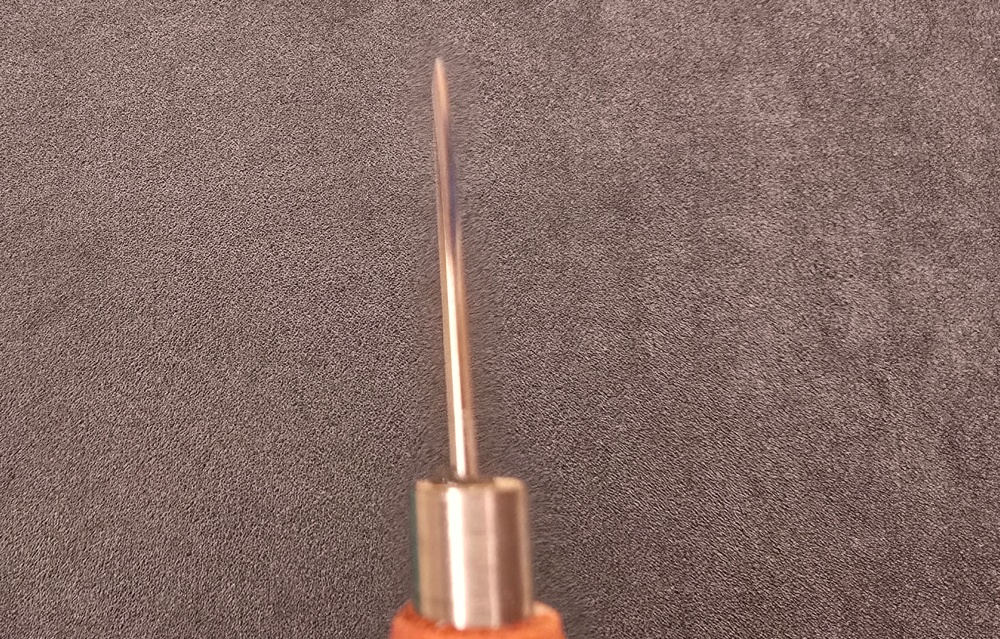
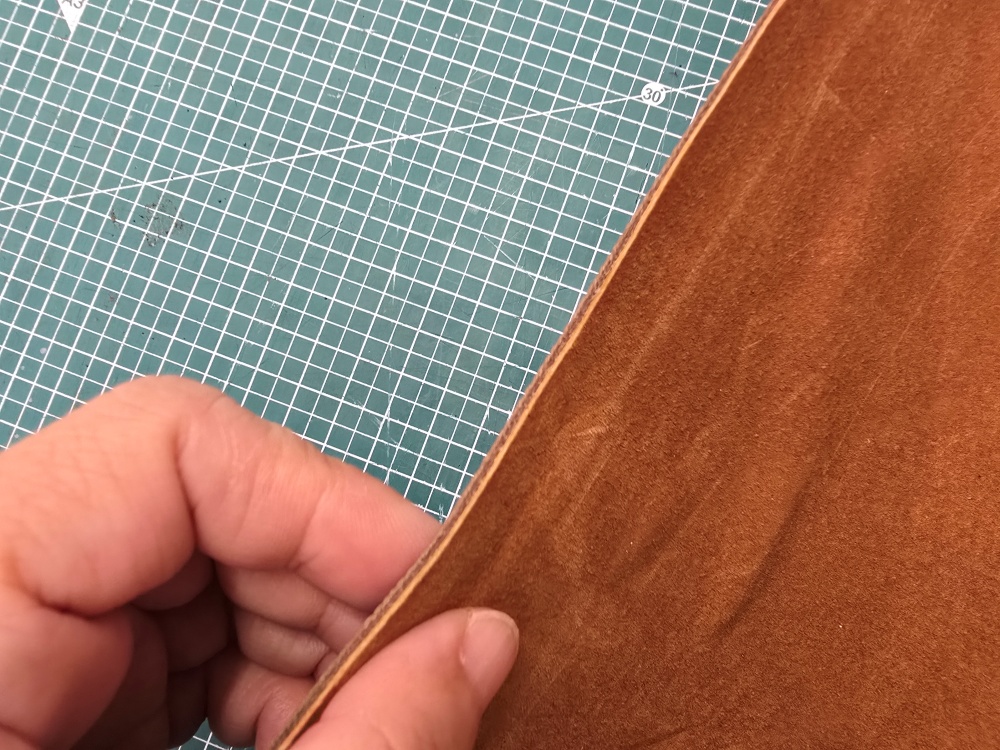
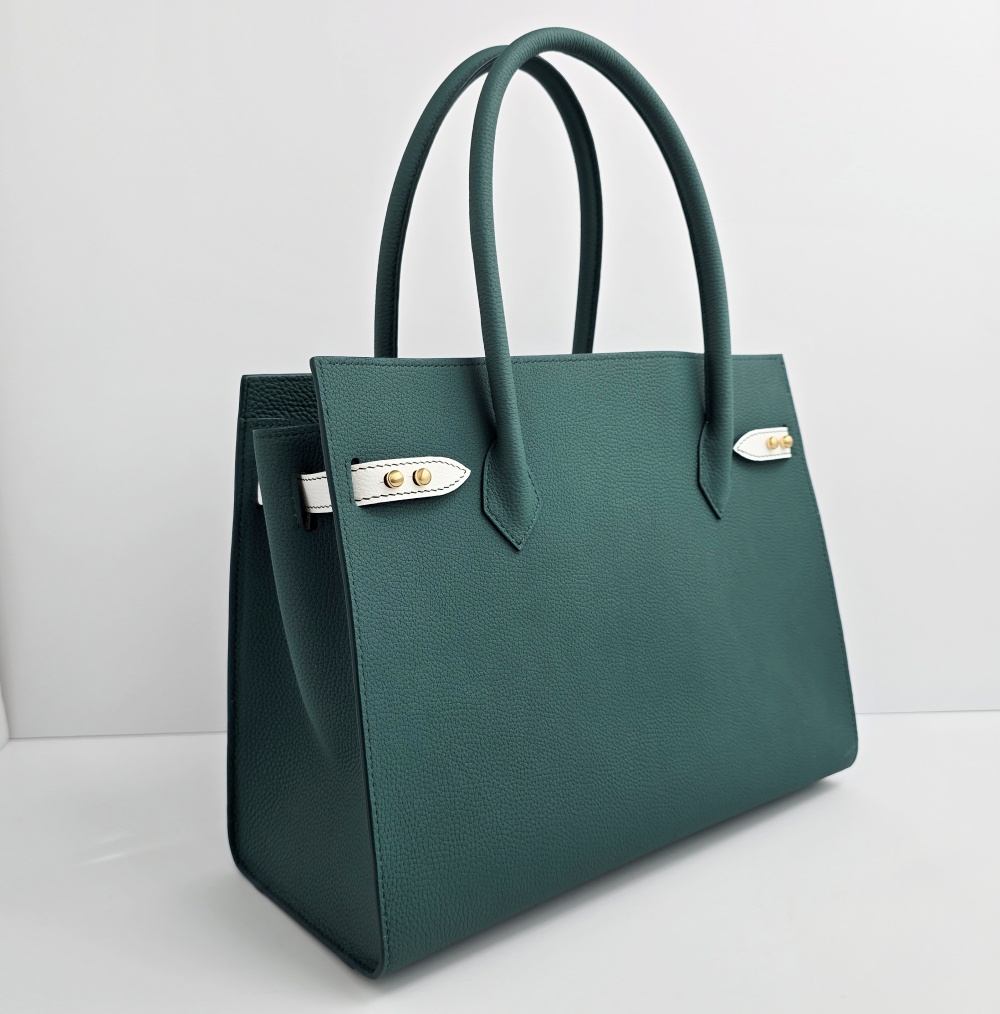
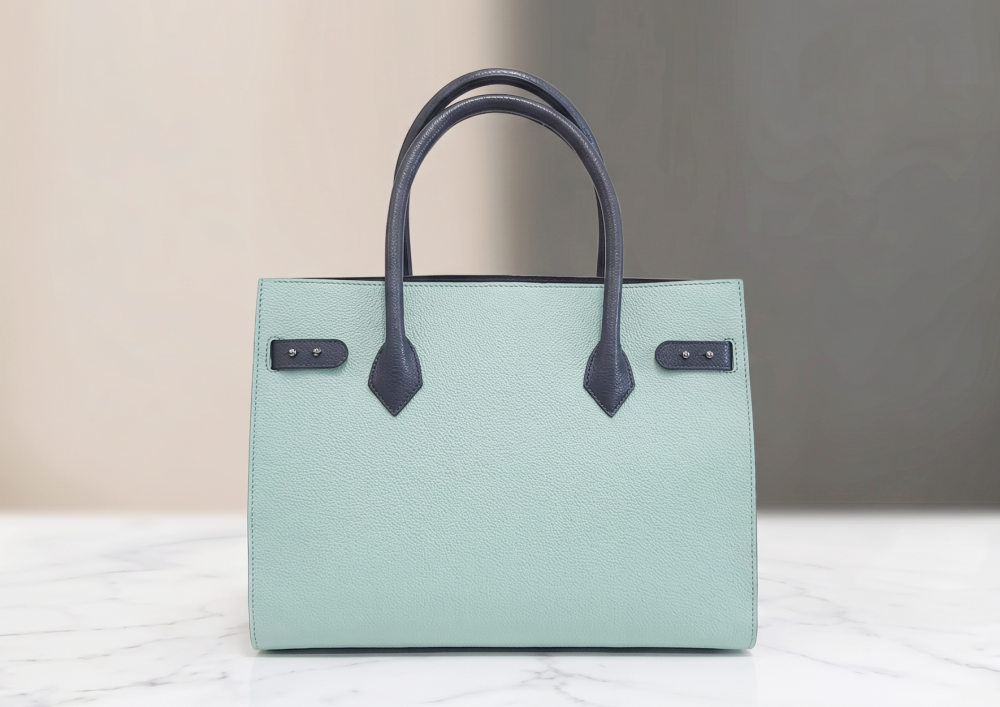
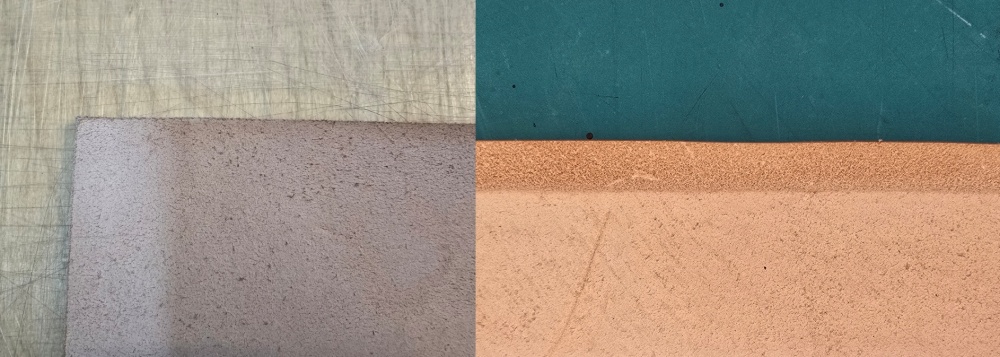
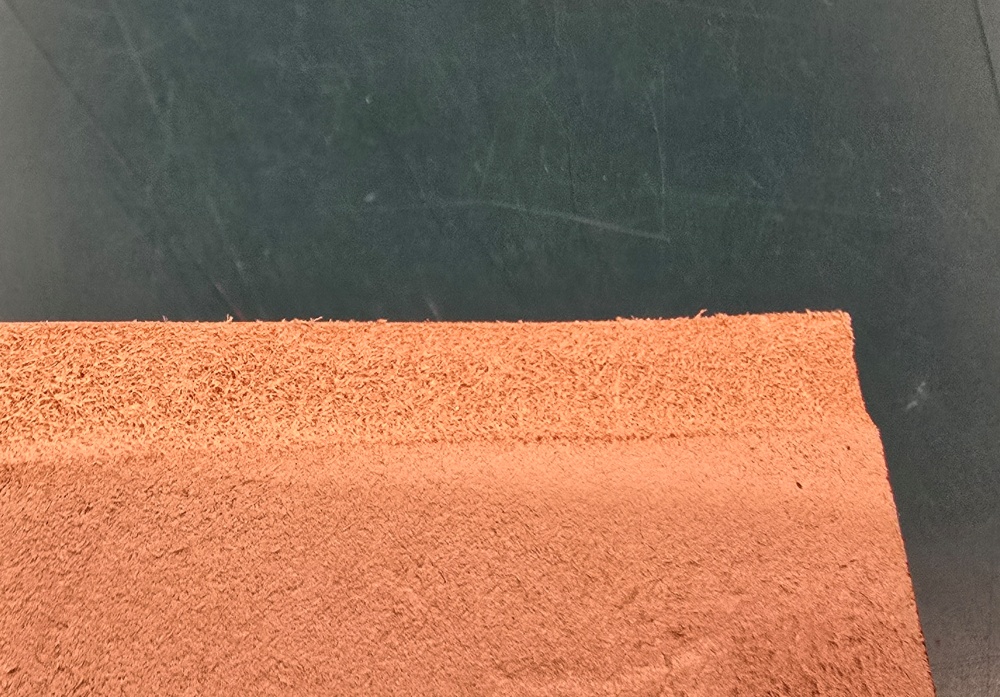
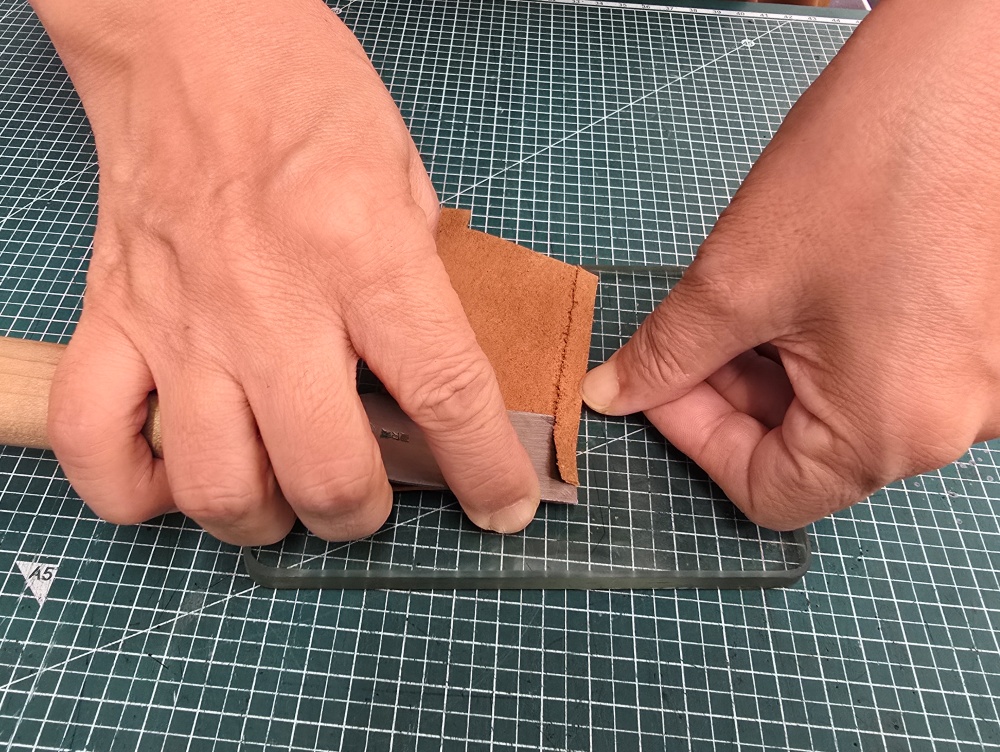
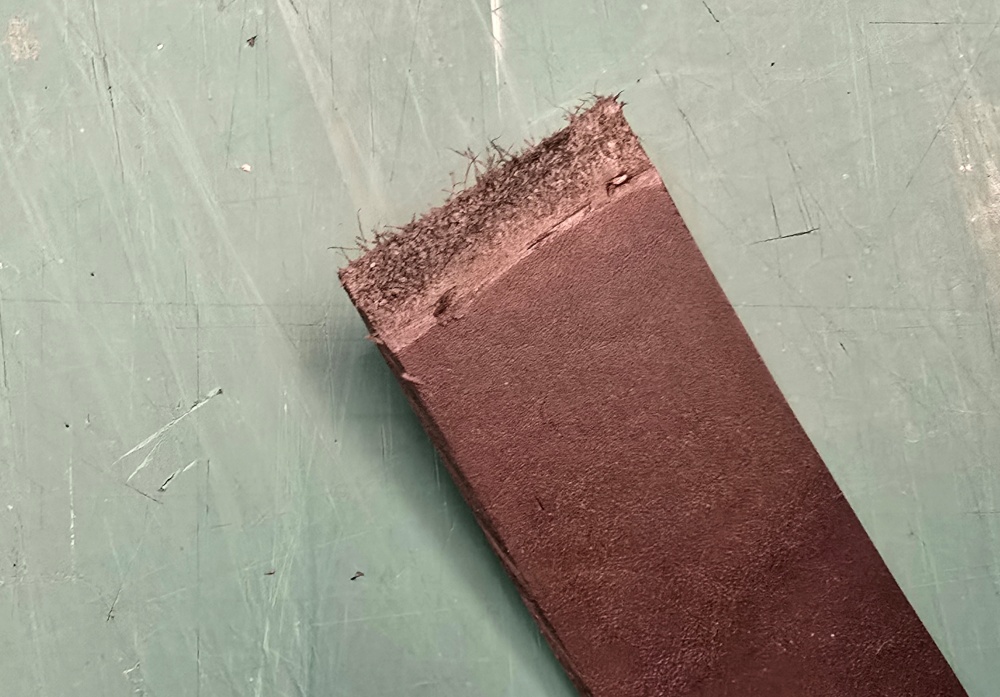
The awl is the most fundamental tool in leathercraft. Beginners often focus solely on pricking irons or needles, but it is ultimately the precision of the awl that determines the stitch quality and the overall class of the final piece.
1. An Awl is Not Just a Hole-Punching Tool
Category
Details
Essence of the Awl
Unlike a drill that destroys fibers, it pushes tissues aside to create a path for the thread.
Core of Quality
Minimizing fiber damage, perfect stitch alignment by maintaining a consistent angle.
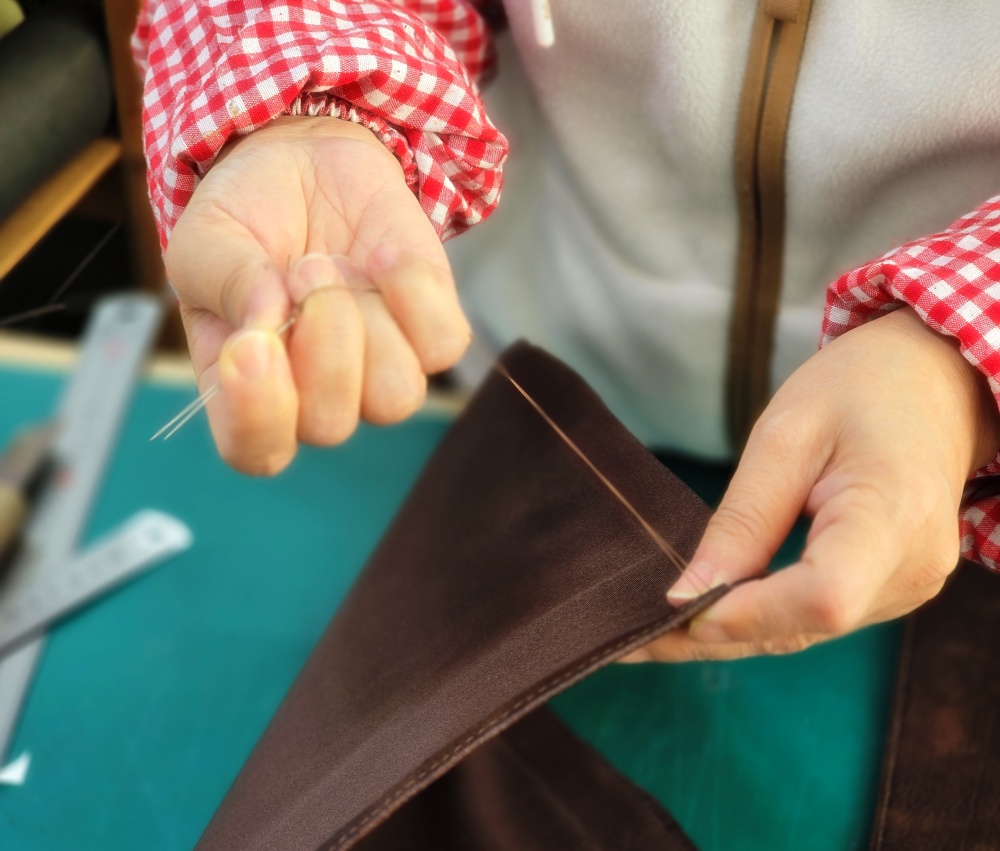
While a drill rotates and 'destroys' leather fibers, an awl pushes the structure aside to create a 'path' for the thread to pass through. If this path is off by even 1 mm, the tension of the stitching collapses, and the entire stitch line becomes distorted.
2. Types of Awls That Determine Workflow Efficiency
Diamond Awl: With a diamond-shaped cross-section, it is essential for bringing out the saddle stitch 's signature diagonal thread pattern.
Round Awl: Ideal for thin leatherswhere tissue damage must be minimized, or for finishing work after punching.
Scratch Awl: Used for precise marking and engraving guidelines before cutting.
3. Yegak's Philosophy: Blade Maintenance and Angle
What I have realized in my 20 years of leathercraft is that a dull awl 'tears' the leather rather than 'piercing' it. The moment I feel even the slightest resistance during work, I immediately sharpen the blade using a strop.
Even with the same amount of force, if the angle of the awl shifts by just 5 degrees, the position of the hole on the back will be significantly different. The sense of maintaining a perfect vertical angle is the difference in mastery and the detail that creates a premium finish.
Conclusion: A good stitch begins not with the needle, but in the path created by a precise awl.
Many who visit leather ateliers or boutique brands believe that using premium leather alone will guarantee a bag retains its shape forever. It is a vague expectation, often phrased as, "Since it's made from the finest French hide, it will surely last a decade without buckling." However, exterior beauty and structural durability do not automatically correlate.
In the world of high-end bag construction, the true force that sustains the form does not emanate from the visible exterior leather, but from the internal architecture hidden deep within. The secret of a masterpiece that refuses to collapse over time and confidently maintains its original silhouette lies entirely within reinforcement engineering.
1. Why Do Certain Bags Sag After Just a Few Years?
No matter how thick and robust the leather used to construct a bag is, carrying daily essentials while constantly bearing the relentless pull of gravity will eventually stretch the leather's inherent fibrous tissue, causing specific areas to sag or warp. Once a bag loses its architectural integrity, it completely forfeits its dignity as a luxury piece, no matter how pristine the grain remains.
When precise structural engineering to support the internal architecture is omitted, the bag fails to endure the internal payload and drastically reaches the end of its lifespan. Because leather inherently possesses plasticity that softens over time, the sophisticated combination of the right reinforcements to mechanically govern this shifting and stabilize the skeletal frame becomes the ultimate key determining the true longevity of the bag.
2. What Exactly is Reinforcement?
Reinforcements are internal architectural materials bonded between the exterior hide and the lining to impart three-dimensional volume, enhance tensile strength in high-stress zones, and optimize load distribution. The characteristics of the five primary materials predominantly utilized in high-end operations are as follows:
Leather Board (LB): Produced by reclaiming natural leather fibers, this material keeps the organic flexibility and texture closest to genuine hide while firmly anchoring the surface. It is chiefly deployed on expansive body panels or areas requiring a skeletal structure.
Texon: Formed by high-density compression of paper pulp fibers, this material yields excellent resilience and highly formidable vertical weight support. Although vulnerable to moisture, it performs exceptionally well when defining crisp, linear edges or preventing the base from sagging under load.
Salpa: A specialized variant of leather board, characterized by being thinner, denser, and significantly more flexible than standard LB. It integrates organically with sections that must endure subtle tensile stress without compromising the supple hand of the leather.
Microfiber Reinforcement: Composed of a high-density microfiber web, it is extremely resilient and highly resistant to tearing. Providing formidable durability while adding virtually zero bulk or weight, it is indispensable for anchor points where load concentrates.
Latex Foam: A rubber-based sponge configuration delivering outstanding resilience and cushioning. It infuses the bag with three-dimensional volume and a plush tactile feel, widely utilized to create luxurious embossing effects or a supple grip.
3. Component-Specific Reinforcement Engineering
Every component of a bag does not endure identical stress. The base facing gravity, the handles frictioned by human hands, and the flap subjected to repetitive opening and closing each demand fundamentally distinct physical mechanics; therefore, utilizing the same reinforcement throughout is strictly forbidden.
Base: As it must entirely support the weight of internal possessions, a combination of high-density Texon or rigid Leather Board possessing the finest load distribution properties must be deployed to ensure a flat rigidity that prevents the center from sagging over time.
Handle Anchor Joints: Because the entire payload of the bag concentrates and pulls on this area, non-stretch microfibers or specialized nylon reinforcements boasting extreme tensile strength must be embedded to fundamentally eliminate the disaster of ruptured stitching.
Opening: This section undergoes frequent structural strain as zippers or magnets open and close. Implementing flexible yet highly resilient Salpa or thin Texon preserves a neat, unwarped linear edge.
Gusset (Side Panels): This is a three-dimensional architecture that must open and close naturally depending on the contents. Thus, rather than rigid elements, mating flexible latex or thin leather board preserves the organic elasticity of the leather, encouraging smooth, natural curves.
Flap: Subjected to continuous, repetitive bending and straightening, it must remain free from creasing. Materials like Texon that cannot recover once creased must be excluded; instead, laminating highly resilient Salpa and latex captures both an elegant volume and a smooth opening feel simultaneously.
4. The Perils of Over-Reinforcement
Inserting more material is by no means a superior design. Excessively layering reinforcements drastically escalates the weight of the bag, turning it into an unwearable burden for the user, while entirely neutralizing the warm, supple tactile qualities inherent to genuine leather, leaving it as rigid and coarse as a plastic box.
True engineering rests upon the absolute precision of calculating the thickness, elasticity of the hide, and the intended purpose of the finished bag to embed the minimal thickness exactly where it is demanded. Reinforcement should never dominate the leather; rather, it fulfills its true duty only when staying silently hidden behind the hide, maximizing the natural majesty of the material.
5. YEGAK's Reinforcement Philosophy: Mechanical Equilibrium of Weight and Longevity
Before cutting leather at my workbench, I first sculpt the deployment architecture of the reinforcements three-dimensionally in my mind. Mindlessly abusing Texon in any structure under the pretext of securing structural longevity is nothing less than artisan laziness. While Texon is brilliant at holding sharp lines, it carries a high risk of inducing leather hardening and warping if it traps moisture within a sealed interior; hence, I strictly ration the use of Texon on gussets prone to shifting or zones undergoing intense twisting.
Instead, anchored by extensive experience, I adhere to a discipline of laminating high-end Leather Board (LB)—which closest mimics the density of natural leather—by skiving it down to decimal millimeter units. Anticipating the trajectory of gravity the bag will endure, and even calculating the speed at which the hide will soften as it ages over the years to control the reinforcement thickness manually—this is the perfect equilibrium of weight and durability pursued by YEGAK, and our uncompromising technical pride.
6. Conclusion
The beautiful silhouette of a luxury bag is never forged by a glamorous exterior hide alone. It is a visual miracle made possible only because the unseen internal architecture quietly sustains and defends it from within. Only the honesty of filling an invisible blueprint with the most flawless mechanics overcomes the passing of decades, completing the heritage of a true luxury masterpiece that can be proudly passed down through generations.
7. The Uncompromising YEGAK Discipline
[Previous Step] Pattern Engineering: Why Proportion Defines Luxury: The Science of Golden Ratios in Bag Pattern Engineering
[Next Up] The Science of Linen Thread: Why Premium Hand Stitching Begins with the Thread
There is a common fallacy among many who visit leather ateliers. When they encounter a stunning bag, they often remain suspended in abstract admiration, remarking that the artisan has "excellent sense" or that the design is simply "sophisticated." They fail to see the true secret hidden behind the vague concept of artistic intuition.
However, in the elite realm of high-end bag construction, beauty is never a product of chance. A masterpiece that transcends fleeting trends and projects a profound sense of stability for decades is the direct result of rigorous calculation and mathematical proportion. Great design does not spring from innate sense; it begins with cold, calculated precision, agonizing over dimensions with a ruler in hand.
1. More Than Just a Drawing
When you closely observe the high-end bags we call luxury items, the dimensions and positioning of their components align with astonishing neatness. The depth of the flap in relation to the main body, the spacing where the handles are anchored, and the width of the gusset all sustain a state of perfect equilibrium.
If you begin drafting based purely on visual sense, the silhouette of the bag will drift with every build, or you will fail to erase a subtle, awkward clumsiness. This is exactly why you must calculate the proportion and balance of every single element before drawing a line. Flawless proportion is the foundational engineering formula that eliminates visual chaos and maximizes the inherent majesty of the material.
2. Structural Integrity
The human eye instinctively searches for visual balance, and the pinnacle of that harmony is the Golden Ratio (1:1.618). From ancient temples to modern smartphones, this proportion instills a sense of stability because the laws of natural growth and the mechanics of three-dimensional volumetric structures find perfect harmony within this specific ratio.
When engineering a bag, the Golden Ratio is not merely applied to a flat, two-dimensional rectangle. It serves as the metric that anchors the visual center of gravity within the three-dimensional structural architecture where the front panel, gusset, and base intersect. A bag engineered upon the Golden Ratio maintains a comfortable, volumetric balance—not just when viewed from the front, but also from an oblique angle or when the user looks down from above—ensuring the eye never drifts unevenly.
3. The Dynamics of Tolerances
When drafting a pattern, the critical component proportions that must be strictly controlled through structural engineering are as follows:
Height-to-Width Ratio: This is the primary structural framework that dictates the first impression of a bag. If the golden proportion of the front rectangle collapses, the bag will appear heavy and dull, or conversely, overly narrow and structurally unstable.
Handle Placement and Spacing: The vertical proportion of the silhouette alters drastically depending on how far the handles migrate from the central axis of the main body. Handles spaced too far apart cause the form to appear sprawled, while handles set too close together make it look visually constricted.
Flap Length: For bags utilizing a closure flap, the critical variable is exactly what fraction of the total front height the flap occupies as it descends. If this ratio drifts, the visual center of gravity shifts entirely, making the bag look top-heavy or sagging downward.
Base Width and Gusset Ratio: The proportion of the base and gussets, which define the volumetric depth of the bag, must interlock organically with the surface area of the front panel. If the gusset is excessively wide relative to the front, the architectural balance breaks down entirely.
4. The Mathematical Geometry of Curves
Proportion is not a mere cosmetic plaything intended to create something visually pleasant. A layout with broken proportions inevitably yields physical and structural defects.
For instance, if you draft the main body excessively tall simply because it looks modern, the internal payload hangs long vertically, stretching the leather downward and causing the structure to buckle prematurely. Conversely, if you assign an overly narrow base while extending the handles long, the center-of-gravity axis wobbles when lifted, concentrating intense tensile stress directly onto the joint seams.
Ultimately, the load bottlenecks at a single point, causing the traditional hand-stitched seams to rupture or the leather to warp violently. In other words, exquisite proportion is synonymous with a state of mechanical optimization that distributes the load of the bag in the most ideal trajectory.
5. Weight Distribution Mechanics
When I am at the workbench drafting a new pattern, I never rush to draw specific lines first. Instead, I step back to visually distill the overarching proportion and volumetric mass of the bag onto the blank sheet, dividing the space mathematically before anything else.
This is because a mere variance of 1cm, or even 5mm, completely transforms the entire presence of a bag. Expanding by 5mm reduces it to a crude utility sack; narrowing it by 5mm charges it with the sharp, crisp tension of a true luxury masterpiece. Refusing to mechanically draw along the grids of graph paper, controlling the exact proportions of the space where the leather will breathe down to fractions of a millimeter—this is the uncompromising authority and philosophy of YEGAK's manual pattern engineering.
6. Conclusion
A great pattern is never just a collection of flat lines drawn on paper to cut out leather. It is a predictive blueprint that anticipates and governs the future of the finished bag—calculating leather elasticity, reinforcement density, and the dispersal of gravity and load. Only a blueprint brought to perfection on paper through flawless proportion can withstand the test of time, yielding a masterpiece that confidently endures twenty years from now.
7. The Uncompromising YEGAK Discipline
[Previous Step] Pattern Engineering: Why Great Bags Are Already Finished on Paper
[Next Up] Bag Reinforcement Engineering: Hidden Structures That Determine Durability
For those who view leather crafting merely as a hobby, a pattern is often considered nothing more than a temporary drawing on paper used to cut leather. They tend to believe that by simply copying a pre-made commercial pattern, scratching the lines onto the hide with an awl, cutting it out, and stitching it together, a bag will effortlessly manifest.
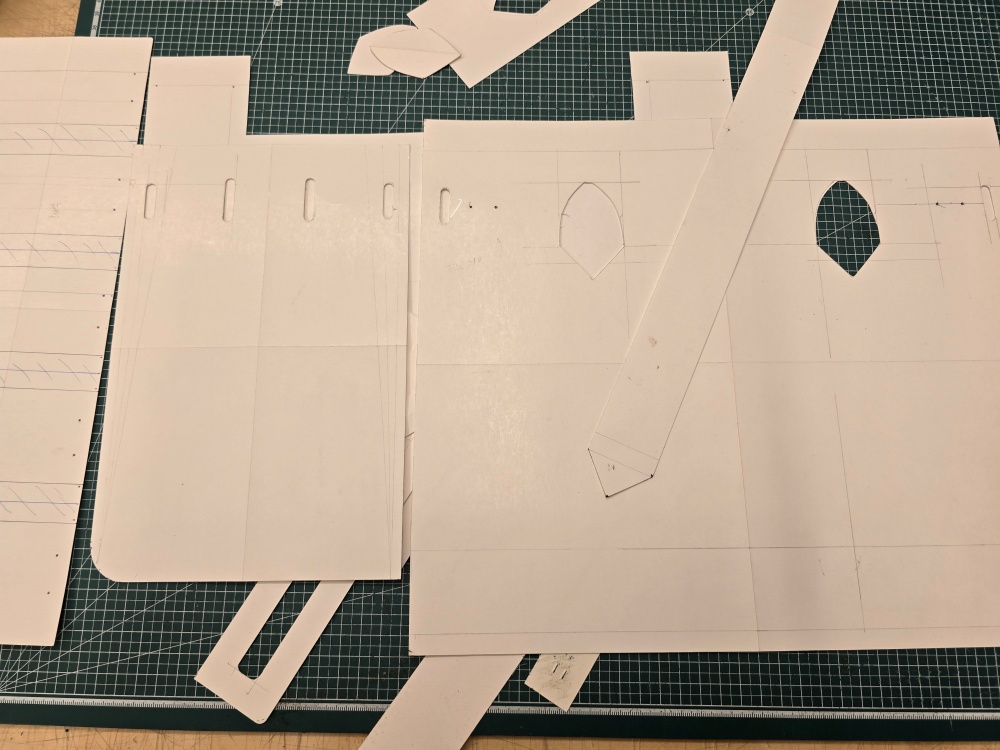
However, in the elite realm of high-end bag construction, a pattern is far more than a basic drawing. It is a highly sophisticated architectural blueprint that calculates and quantifies the exact thickness of the leather, the structural density of internal reinforcements, the physical tolerance during assembly, and the mechanical forces of gravity acting upon the finished form. In essence, a great bag is already finished on paper; its fate and structural integrity are determined long before a knife ever touches the leather
1. More Than Just a Drawing
Pattern engineering is deeply rooted in architecture rather than art. It is a precise mathematical discipline where flat sheets of heavy paper are systematically drafted and combined to ensure that when the exterior shell and internal reinforcements are physically joined, they sustain a flawless three-dimensional volumetric structure.
Leather is a "living, organic medium"—its fiber orientation, shrinkage rates across different sections, and structural plasticity when introduced to moisture vary constantly. A pattern drafted solely by visual dimensions, without calculating these volatile physical parameters, will never achieve the caliber of a true masterpiece, regardless of how premium the leather is or how precise the saddle stitching appears on the surface.
2. Structural Integrity
When a bag prematurely sags or deforms over time, most crafters quickly blame the choice of internal reinforcements or uneven thread tension. However, the fundamental root of structural failure almost always traces back to the drafting phase—specifically, the failure to calculate material displacement during three-dimensional assembly.
When the exterior leather, internal lining, and rigid reinforcements are layered and bent along a curve, the inner layers must structurally be shorter than the outermost layer. If this microscopic dimensional balance is not tightly controlled on paper down to fractions of a millimeter, the leather will buckle or warp the second the panels are bonded. The crisp lines, proportion, and self-standing majesty of a bag must be absolute on the pattern before assembly begins.
3. The Dynamics of Tolerances (Seam Allowance)
The most catastrophic structural dimensional errors occur within the calculation of seam allowances. As the physical thickness of the leather substrate increases, the geometric gap between the expanding outer circumference and the compressing inner radius widens drastically whenever panels intersect.
When drafting a pattern by hand, a master artisan carefully calculates the specific thickness of the exterior leather, the density of the lining, and even the microscopic volume of the adhesive layers to assign unique skiving margins and seam allowances to each separate panel. If these intricate calculations are slightly off, the entire layout drifts, causing stitching lines to warp diagonally or rendering structural assembly physically impossible.
4. The Mathematical Geometry of Curves
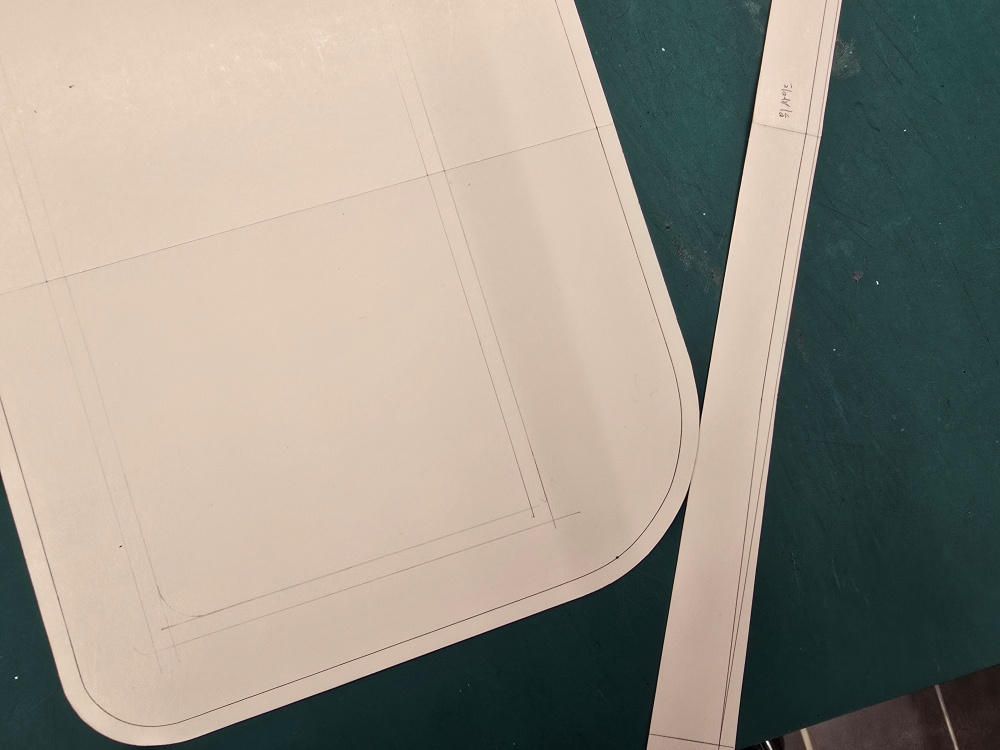
The sweeping, elegant corner arches that define a luxury silhouette or the radical contours of an inverted gusset cannot be accurately generated with basic flat rulers.
Even if a curved line and a straight line measure exactly the same length on a flat surface, when they are manipulated into a three-dimensional plane, the leather fibers along the curve compress or stretch, altering the true mating length. Rejecting standard grid papers, YEGAK utilizes manual axial and cross-pattern drafting techniques to thoroughly simulate the physical resistance at the precise intersections of radii (R-values) directly on the paper, achieving an absolute mechanical match.
5. Weight Distribution Mechanics (Center of Gravity)
A flawlessly engineered bag maintains its clean geometric profile even when loaded to capacity, ensuring that the mass does not awkwardly lean or shift when held by the handles. This represents the pinnacle of pattern engineering: Center of Gravity Architecture.
The exact mounting angle of the handles, the surface area of the attachment lugs, and the precise boundaries of the bottom base reinforcements must be calculated to strategically distribute stress. A pattern with flawed center-of-gravity engineering will tilt forward or backward when lifted, concentrating intense tensile stress onto a single joint, causing the structural thread lines to rupture and the leather to permanently deform.
6. The Inevitability of Poor Design
Even if a crafter possesses decades of hands-on experience at the workbench, a flawed pattern forces them to forcefully stretch, pull, or cram the leather during assembly to make the edges meet. A bag built under artificial structural stress may look passable on day one, but over time, the inherent elastic memory of the leather will violently pull back toward its true state, causing the entire bag to buckle and sag inward.
To build a true long-term asset that confidently endures for over twenty years, an artisan must never rely on temporary sensory adjustments to coerce the leather. Instead, the material must be guided to rest completely naturally within the absolute, mathematically verified dimensions of an engineered pattern.
7. The Uncompromising YEGAK Discipline
YEGAK strongly rejects over-reliance on digital CAD printouts or highly standardized commercial grid papers. Cold, automated lines can never truly capture or account for the organic elasticity, grain resistance, and nuances of a living hide.
Erecting the primary axes and strict perpendicular guidelines directly by hand, projecting the volumetric density of leather and reinforcements onto the raw paper—this is the very essence of the "slow but solid" pattern engineering philosophy that YEGAK safeguards. Controlling a 0.1mm gap on a sheet of draft paper is the absolute boundary that segregates fine art from commercial mass production.
Next Level: The YEGAK Knowledge Graph
[Previous Step] Thread Tension and Material Resistance: The Structural Equation of the Traditional Saddle Stitch
[Next Up] Thread Character and the Function of Aging: Natural Linen Thread vs. Polyester Thread
Those who have not deeply experienced leather crafting often think of stitching as simply a finishing act to connect cut pieces of leather. They might ask if it really matters whether it is stitched rapidly by a sewing machine or sewn stitch by stitch by an artisan's hands, as long as the resulting thread line looks beautiful on the surface.
However, from the perspective of high-end leather engineering, stitching is not a mere combination. It is a "Structural Engineering" technique that determines the lifespan of a leather product. Today, we will explore the scientific reasons why traditional high-end leather workshops still insist on the "Saddle Stitch," a method dating back centuries, by looking closely at its structural differences from machine sewing.
1. What is the Saddle Stitch?
Definition and History
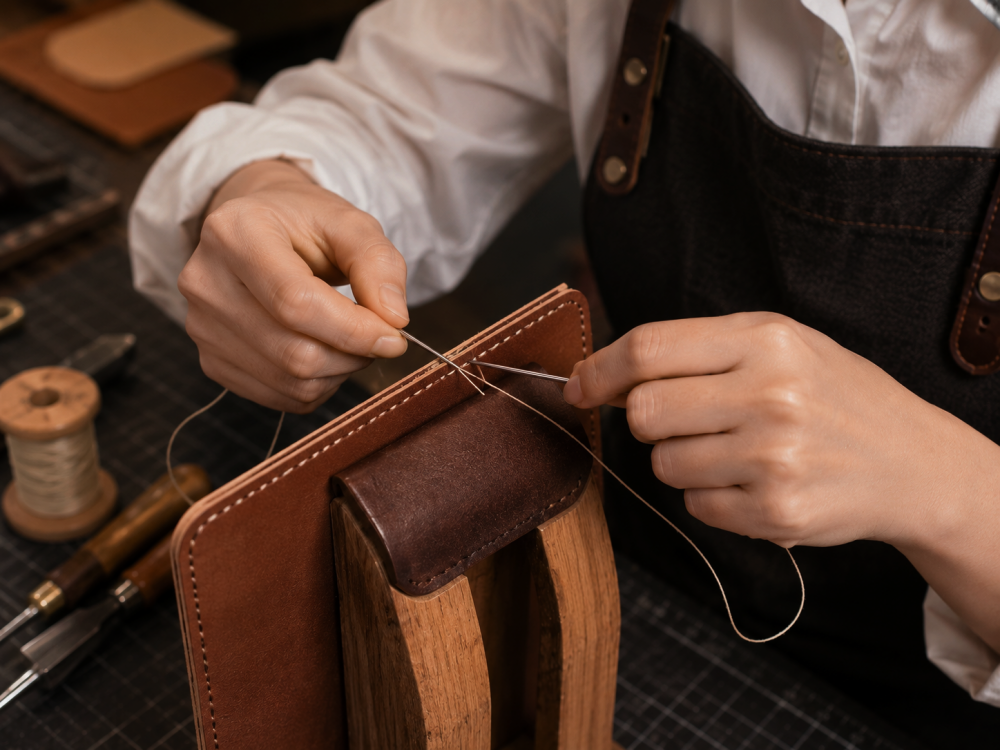
The saddle stitch, as the name suggests, is a traditional hand-stitching technique originally used when making a horse's "Saddle." It involves connecting a needle to each end of a single thread, utilizing a total of two needles to cross both threads through a single punched hole. A saddle had to fully withstand the rough movements of a horse and the weight of the rider, which meant it required the toughest and most durable structure humanly conceivable.
Why is it Still Used in High-End Bags?
No matter how much cutting-edge computer sewing machines have developed today, the reason traditional high-end workshops insist on this demanding hand-stitching method is simple. It is due to its "independent durability" that machines can never replicate, combined with the refined proportional beauty unique to handwork. ..
2. The Critical Structural Difference Between Machine and Hand Stitching
o understand the difference between machine sewing and the saddle stitch, we must examine the "structure of the knot" and how the threads interlock inside the leather layers.
Category
Lock Stitch
Saddle Stitch
Number of Threads
Top and bottom threads
(2 different threads)
Two needles on a single thread
(1 continuous thread)
Interlocking Method
Threads simply loop and twist past each other inside the leather
Two threads completely cross and knot over each other inside the hole
Tensile Stress
If one part breaks,
it unravels like dominoes
If one part breaks, the oppositethread maintains the structure
The Limitation of Machines: The Lock Stitch
A sewing machine works by having the top thread pierce through the leather to catch the bottom thread like a loop, pulling it back up. In other words, the two threads are merely "loosely hooked" to each other inside the leather. This structure has a fatal weakness. The moment a single stitch is severed due to friction, the tension holding the upper and lower threads is lost, causing three or four stitches to completely unravel in a domino effect.
The Strength of Handwork: The Saddle Stitch
On the other hand, the saddle stitch allows two lines of thread to cross perfectly in forward and reverse directions within a single hole. It forms a shape where the thread wraps tightly around the inside and outside of the leather like a Möbius strip. This structural difference dictates the lifespan of the bag.
3. Why is the Saddle Stitch More Durable? The Scientific Principle
The Principle of Independently Secured Threads
Every time the saddle stitch passes through a leather hole, the threads form a knot as they move over. Because the two threads are tightly twisted by strong friction inside the leather, each individual stitch is secured as an entirely independent unit.
The Difference When One Thread Breaks
Suppose a bag has been used for years, and one line of thread on a high-friction corner finally wears down and breaks.
A machine-sewn bag unravels, the leather gap opens up, and the internal reinforcement materials become exposed.
In contrast, a saddle-stitched bag remains secure. The other line of thread coming from the opposite side continues to hold the leather together tightly, maintaining its tension thanks to the twisted structure inside the hole. This is the scientific secret that allows hand-stitched bags to be passed down through generations.
4. Why an Artisan Chooses the Saddle Stitch Over Machines
Durability
Thanks to the structural resilience mentioned above, it perfectly withstands intense friction and the tensile stress caused by the weight of internal belongings.
Repairability
When a machine-sewn bag unravels, the entire line of stitching must often be ripped out and resewn from the beginning to look neat. In contrast, a saddle stitch allows for partial repairs (Après-vente), seamlessly blending a few new stitches exactly where the thread broke.
Aesthetics
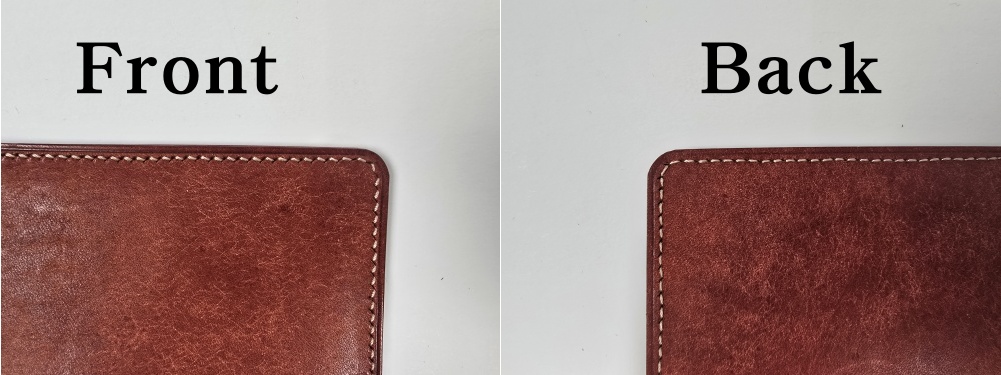
Driven by the consistent tension of an artisan's hands along the pricking iron marks, the thread creates a flowing, three-dimensional diagonal slant that no machine can match. The symmetrical beauty between the front and back sides makes it a work of art in its own right.
5. YEGAK's Standards: An Obsession with Structural Perfection
At YEGAK, we reject stitching that serves as mere visual decoration. We only permit precise stitches that calculate the density of the hidden inner walls and reinforcement materials of the bag.
Thread Selection: Instead of the artificial gloss provided by synthetic threads (polyester), we insist exclusively on premium natural French linen thread. It ages beautifully alongside the leather, settling deep into the leather fibers over time.
Stitch Spacing: Depending on the size of the bag, the thickness of the leather, and the combination of reinforcements, we specify the exact stitch count during the manual pattern design phase, ranging from size 7 (3.85mm) to size 9 (3.0mm). If it is excessively dense, the leather will tear; if it is too wide, the structural stability compromises.
Needle Selection: We carefully select and use premium British saddle needles with rounded, precisely finished tips to ensure they glide smoothly through the leather fibers without forcefully tearing the internal structure.
6. Conclusion
"Saddle Stitch is not simply a sewing method. It is a structural engineering technique that determines the lifespan of a leather product."
Slow but solid—crossing two needles to fill a single stitch takes dozens of times longer than a machine. However, that density of time becomes the lifespan of the bag, and it is the value YEGAK refuses to compromise on.
In the next chapter, we will take an engineering approach to the foundation of the saddle stitch: "The Differences in Tensile Strength and Aging Between Natural Linen Thread and Polyester Thread."
The Tale of Two Edges: Demystifying Leather Skiving Techniques
Walk into any high-end leather atelier, and you will find a tool that artisans constantly maintain: the skiving knife. Yet, many intermediate crafters often find themselves confused by technical terminology. Specifically, what is the actual mechanical difference between Standard Skiving and French Skiving?
Choosing the wrong technique at a critical seam is the exact reason a bag fails to lay flush like a Hermès piece, turning instead into a bulky, amateurish lump. Let's deconstruct the mechanics of these two essential disciplines.
1. Standard Skiving (Bevel Skiving): The Linear Incline
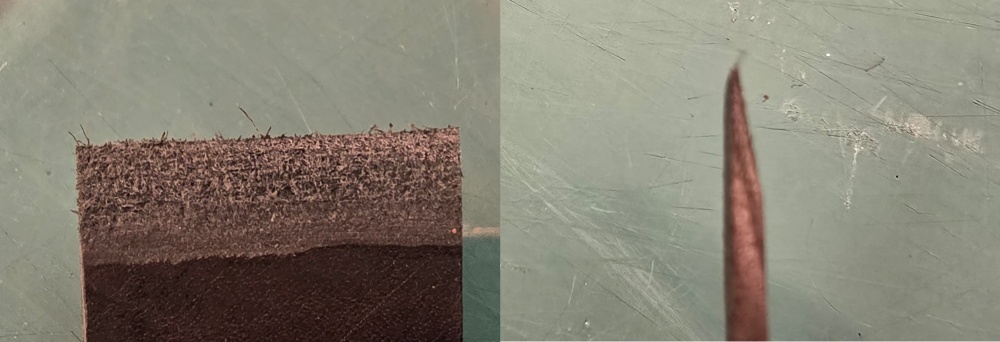
Standard skiving—often called edge beveling—is the process of shaving the leather perimeter at a consistent, diagonal angle (usually between 15° to 30°).
The Geometry: It creates a smooth, continuous slope from the full thickness of the leather down to a feather-thin edge (e.g., sloping from 1.4mm down to 0.1mm)
When to Use It: This is your go-to technique for basic raw-edge construction. When you are stitching two panels together and painting the edge with edge coat (giardini/fenice), standard skiving eliminates the double-bulk, keeping the final edge sleek and uniform.
2. French Skiving (Channel Skiving): The Architectural Step-Down
French skiving is a highly specialized, advanced technique where you carve a flat-bottomed rectangular channel into the leather's flesh side, rather than a diagonal slope
The Geometry: It creates a sharp, right-angled step-down (⎔). The center of the channel is perfectly flat and uniform in thickness.
When to Use It:** This is absolutely mandatory for **turn-top folded edges (시접)**, pocket T-slots, and premium wallet card slots. By carving a 0.6mm flat channel into a 1.4mm panel, the leather folds over with crisp, geometric perfection. It prevents the folded seam from bloating or creating an awkward exterior bump.
📊 Quick Reference: Technical Comparison
Technical Attribute
Standard Skiving (Edge Bevel)
French Skiving
Cut Shape
Diagonal Slope ( /
Flat-Bottomed Step ( ⎔ )
Primary Tool
Japanese Utility Knife / Round Knife
French Edger / Flat-nosed Chisel Knife
Best Used For
Raw-edge joinery, edge painting
Folded edges (turn-top), T-slots, lining tabs
Difficulty Level
Medium (Requires steady hand angle)
High (Requires exact depth control)
3. Beginner Pitfalls: The Cost of a Dull Blade
Achieving a clean French skive on a soft, premium chrome leather (like French Crispe Goatskin) is notoriously difficult for beginners. Here are the two most common mistakes recorded in the YEGAK archive:
The Chattered Gouge: Because chrome leather stretches, a dull blade will "hop" and bite into the leather unevenly, leaving ugly corrugated gouges. When you apply water-based adhesive, these uneven depths telegraph directly onto the smooth exterior grain
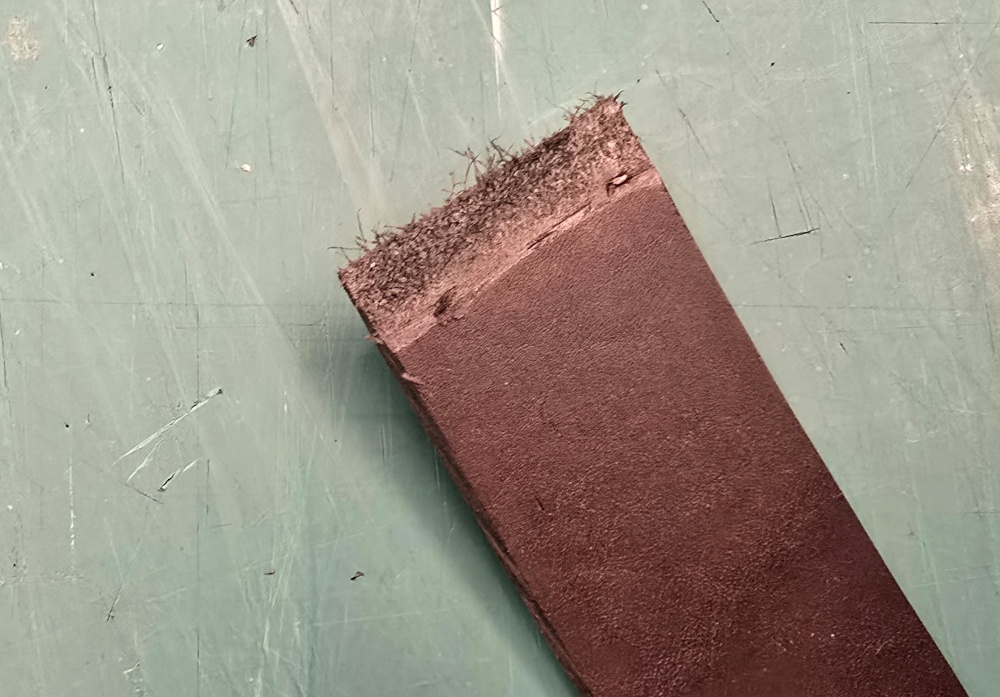
The Perimeter Rip:During a standard bevel skive, if the artisan pulls the knife too aggressively at the very edge, the thin 0.1mm foil of leather will stretch and tear, ruining the entire panel alignment
The Master's Secret: Mirror-Polished Maintenance
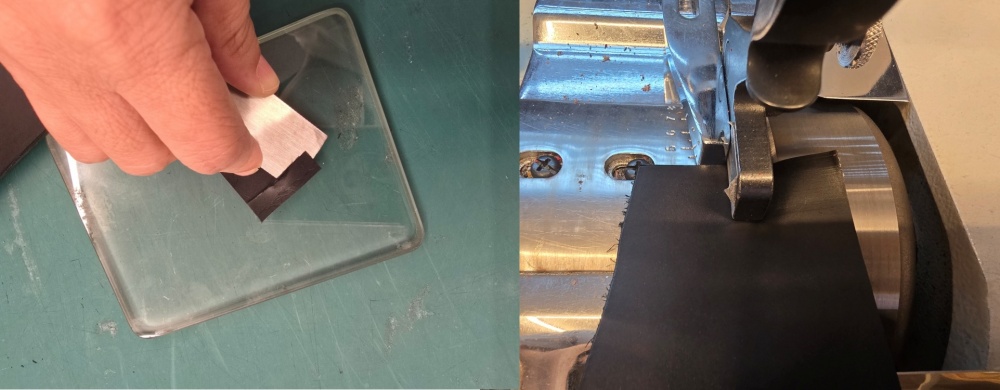
The secret to taming soft chrome leather isn't brute force; it is microscopic sharpness. Before executing a French skive, a master artisan always strops the blade on leather loaded with chromium oxide compound until it achieves a mirror finish. The blade must effortlessly slice through the dense collagen fibers using only the weight of the hand.
The YEGAK Knowledge Graph: Internal Link Building
To master the complete physical architecture of high-end bag building, connect this practical guide with our foundational engineering theories:
The Master Framework:** Dive deeper into the microscopic world of collagen networks and knife angles in our comprehensive guide: [The Science of Leather Skiving: Taming Fiber Density with Razor Precision]."Why Skiving is More Than Just Thickness Adjustment"].
Shaving the Invisible: Why Skiving is More Than Mere Thickness Control
To the untrained eye, leather skiving is merely a mechanical task of shaving down the surface to make the hide thinner. However, to a high-end artisan, skiving is a highly sophisticated process of engineering calculations to precisely redistribute structural strength. It serves as the invisible foundational framework that determines whether a bag will maintain its razor-sharp architectural silhouette or slowly collapse from the seams.
Raw, natural hides exhibit inconsistent structural densities across different quadrants. By utilizing a razor-sharp knife to control this fiber matrix at a microscopic level, the artisan gains absolute command over exactly where the leather must yield flexibly and where it must remain perfectly rigid.
Key PointKey Point) Skiving is not an act of whittling away the essence of the leather; it is a deliberate recalculation of physical thickness to achieve seamless three-dimensional joinery and fluid structural transitions.
1. Micro-Mechanics: Collagen Fiber Density and Blade Resistance
Every square millimeter of full-grain leather possesses its own unique internal matrix. The upper grain layer (corium) houses a tightly interwoven network of collagen fibers, exerting immense tensile strength. Conversely, descending toward the lower flesh side, the fibers disperse in a loose and irregular matrix.
As the skiving knife penetrates this organic web, the blade encounters constantly fluctuating resistance vectors. If the artisan's blade is not polished to a mirror finish, it will fail to shear the fibers cleanly, instead pushing or tearing the loose underlying tissue. Precision skiving initiates with a profound, tactile comprehension of this structural density through the fingertips. The artisan continuously calibrates the knife angle in real time to glide smoothly through the dense fiber walls without inducing structural stress within the leather.
2. Architectural Technique: The Dichotomy of French Skiving and Standard Beveling
In premium construction, a simple diagonal bevel is never sufficient. YEGAK classifies this margin control as a strict technical discipline.
Standard Edge Beveling: A technique that shears a linear slope at a single angle along the perimeter. It is primarily utilized to reduce the clumsy bulk of raw margins prior to basic stitched joinery.
French Skiving (Channel Skiving): A highly sophisticated, stepped skiving discipline. The artisan precisely excavates a flat-bottomed rectangular channel into the flesh side of the leather. This is the foundational technique that allows wallet card slots (T-slots) or concealed fold lines to bend with razor-sharp clarity, laying completely flush without protruding clumsily.
3. Structural Standards: Precise Thickness Calibration for Individual Parts
A master artisan executes distinct mechanical formulas dictated by the physical stress points concentrated on the bag. Below are the rigid technical benchmarks enforced within the YEGAK curriculum.
Folded Edges (Turn-Tops): Margins of a 1.4mm panel are micro-skived down to a 0.6mm gauge, securing an absolute flush interface when folded over.
Zipper Terminals: Shaved down sharply to 0.4mm to accommodate the thick canvas fabric of luxury zippers while blocking any clumsy accumulation of bulk.
Corner Gussets: Compound skiving is executed across multiple vectors down to 0.5mm to realize complex, three-dimensional curves, allowing the leather to wrap around radiuses seamlessly without creasing.
Handle Tabs: As core load-bearing components supporting the bag's full weight, these structures maintain a substantial thickness of 1.2mm to 1.5mm, utilizing minimal beveling to preserve the dense, natural fiber networks.
Artisan’s Note A finely tuned blade exposes the integrity of the tannery. If the leather tissue delaminates or tears apart during a 0.5mm micro-skive, it serves as evidence that the hide lacks the collagen density required to anchor a high-end architecture over the long term.
4. The Anatomy of Failure: The Structural Cost of Faulty Skiving
Improper skiving stands as the primary culprit behind the premature structural collapse and diminished lifespan of a handmade leather object.
The Over-Skived Tear: Shaving a mere 0.1mm too deep cleanly severs the dense corium layer, leaving only weak flesh-side strands. Under physical tension, this boundary inevitably ruptures.
The Compressed Wrinkle: A dull blade pushes fibers forward instead of shearing them. This induces a subsurface accumulation of tissue, manifesting on the grain face as irreparable, erratic wrinkling post-assembly.
Delamination: An inconsistent, gouged skiving path prevents premium water-based adhesives from forming a continuous molecular bond, triggering catastrophic structural separation when exposed to shifting humidity levels.
5. Calibrating the Blade: The Equation of Golden Equilibrium
How does one tame fiber density with razor precision? The artisan continuously calculates three interconnected variables:
Material Moisture Content: The structural elasticity of vegetable-tanned fibers responds sensitively to shifts in atmospheric humidity.
Blade Geometry: The exact angle of the blade's bevel commands the initial resistance threshold encountered upon entering the dense collagen matrix.
Anatomical Grain Direction: Mapping pattern orientation and cutting vectors according to whether the hide quadrant is a rigid shoulder, a dense butt, or a loose flank.
The YEGAK Knowledge Graph: Internal Link Building
To command absolute control over high-end architecture, precision skiving mechanics must be flawlessly synchronized with material science and traditional stitch work. Continue your technical evolution:
Foundational Asset #1: Review the core chemical architecture of your canvas in [The Ultimate Guide to Vegetable-Tanned Leather].
Foundational Asset #2: Master the physics of material thickness in [How Leather Thickness Determines Structural Integrity].
Next Technical Discipline: Decoding the Mechanical Tension of Joinery – [The Science of the Saddle Stitch: Secrets of Thread Trajectory and Silhouette Control] (Upcoming Release)
Advanced Engineering: Commanding the Geometry of Equilibrium – [Pattern Engineering: Architectural Stability and the Golden Ratio] (Upcoming Release)
Architectural Language: Why 0.1mm Defines a Masterpiece
In high-end leathercraft, the thickness of leather is never a mere dimension; it is a core architectural language that determines the structural survival of a design. A variance of just 0.1mm serves as the absolute boundary dividing an unidentifiable, collapsing object from a luxury masterpiece that preserves its golden ratio for decades.
For the artisan, calibrated control of material thickness is the very first and most rigorous calculation. This guide deconstructs the physical mechanics, micro-skiving techniques, and interlining principles required to evolve a raw hide into a self-supporting leather structure.
Key Point In premium bag construction, leather is treated not as a supple textile, but as a structural beam; a shift of 0.1mm instantly alters the material's mechanical resistance and load distribution.
1. Material Mechanics: Leather Thickness and Flexural Stiffness
To build a bag without structural collapse, one must understand flexural stiffness ($D$). In structural engineering, the capacity of a flat surface to resist bending scales exponentially with thickness. This mathematical relationship is non-linear, operating instead as a cubic function ($D \propto t^3$).
Doubling the thickness of a leather panel increases its resistance to bending and sagging by an overwhelming factor of eight. Conversely, carelessly over-skiving a mere 0.2mm instantly obliterates more than 50% of the leather's natural structural stiffness. This is precisely why a YEGAK artisan never works by intuition; we rigorously analyze the tissue density of European calfskin to determine the exact thickness required to defy gravity.
2. The Structural Blueprint: Optimal Dimensions Across Leather Genres
Every leather object demands its own mechanical equilibrium. Below are the rigid thickness standards enforced within the YEGAK curriculum to reconcile structural durability with artisanal refinement.
Small Goods (Card Wallets, Pouchettes): Exterior panels must be precisely calibrated between 1.2mm and 1.5mm to yield a firm, resilient tactile experience. Internal card slot layers are skived down to 0.6mm–0.8mm, ensuring the wallet does not bulge clumsily when cards are inserted.
Tote Bags & Unlined Daily Bags: Main body panels require a substantial weight of 1.5mm to 1.8mm. Within this threshold, the bag achieves an elegant, organic drape without forfeiting its structural perimeter silhouette.
Structured Boston Bags: The principal architectural walls are maintained at 1.2mm to 1.4mm, mechanically coupled with a deliberately engineered interlining core. The base panel, which bears the entire load vector of the bag, demands a full-grain leather base of at least 2.0mm.
Rigid Box Bags & Doctor's Bags: To securely anchor a heavy internal frame and execute razor-sharp, three-dimensional geometric corners, the core gussets command an uncompromising thickness of 1.8mm to 2.2mm.
3. Micro-Skiving: The Art of Seamless Three-Dimensional Joining
Raw hides delivered from tanneries exhibit inconsistent thicknesses across different quadrants; precision skiving is mandatory to tame these deviations. High-end assembly mechanics demand exacting French skiving and micro-edge beveling.
Shaving the margin of a 1.4mm panel down to a seamless 0.6mm taper allows the artisan to fold the edge over itself, yielding an ultra-sleek joinery interface free of clumsy bulk. A flawed thickness ratio where two panels intersect introduces internal structural tension, which, over time, warps the stitch lines and stresses the thread matrix. Proper micro-skiving is the sole method to render all seams completely flush and structurally continuous.
Artisan’s Note A finely tuned utility knife exposes the true structural integrity of the hide. If the leather warps or tears during a 0.5mm edge skive, it stands as proof that the hide lacks the collagen density necessary to anchor high-end architecture.
Thickness alone cannot solve every architectural challenge; natural leather remains an organic skin that inherently yields to tension under sustained humidity and physical stress. To secure permanent geometric stability, the artisan strategically pairs skived leather with specialized European interlinings.
Leatherboard (Salpa / LB): Composed of compressed recycled leather fibers, it bonds with 1.0mm leather to replicate the dense, rigid hand-feel of a 2.0mm panel without adding excessive weight.
High-Density Texon: An unyielding cellulose matrix inserted like a mechanical heart inside bag bases or rigid handle structures to guarantee shape retention.
Premium Latex & Microfiller: Layered beneath a 1.2mm side panel, these materials provide a luxurious, high-resilience spring-back memory, completely preventing the panel from premature sagging or creasing.
5. The Artisan's Criterion: Calculating the Golden Equilibrium
How does a master artisan close the final structural equation? We evaluate three organic variables:
Tannage Type: The structural rigidity inherent in a 1.2mm vegetable-tanned leather is often significantly superior to that of a supple 1.8mm chrome-tanned leather.
Grain and Fiber Direction: Cutting patterns parallel to the animal's spine yields maximum resistance against distortion; utilizing the belly region demands additional structural reinforcement or thickness compensation calculations.
Intended Silhouette: Mapping with perfect clarity the fluid zones where the bag must organically yield to movement, versus the rigid architectural vectors that must remain permanently fixed.
🌐 The YEGAK Knowledge Graph: Recommended Reading
To command absolute control over high-end architecture, material thickness must be perfectly synchronized with professional mechanics and geometric design. Continue your technical evolution through our official curriculum:
Foundational Asset: Review the chemical foundations of structural rigidity in [The Ultimate Guide to Vegetable-Tanned Leather].
Next Technical Discipline: Mastering Blade Physics - [The Science of Leather Skiving: Taming Fiber Density with Razor Precision] – Upcoming Release
Advanced Engineering: Decoding the Geometry Behind Structural Equilibrium - [Pattern Engineering: Architectural Stability and the Golden Ratio] – Upcoming Release
Structural Logic and Material Mechanics for High-End Leather Crafters
If leathercrafting is defined merely as the act of cutting, punching, and stitching leather according to a pre-existing pattern, then a deep technical understanding of the material might be an unnecessary luxury. However, if your goal is to engineer a timeless masterpiece that preserves its structural stability for decades, the beginning of every design equation must unquestionably be Vegetable-Tanned Leather.
This guide deconstructs the true mechanics and physical proportions hidden beneath artificial coatings, demonstrating the structural essence of why high-end artisans reject the convenience of mass production to demand this challenging material.
1. Chemical Processing vs. Botanical Properties (Chrome vs. Vegetable)
To master a material, one must first understand the essence of its creation. Today, over 90% of the leather circulated in the global market is Chrome-Tanned Leather. This method utilizes chemical agents such as chromium sulfate and heavy mineral salts to complete the tanning process en masse in a matter of hours. While chrome leather is highly advantageous for mass production—being lightweight, supple, and resistant to stains—it chemically alters the protein fiber structure within the hide completely. This alteration eradicates the leather’s inherent "structural memory," rendering it impossible for an artisan to mechanically control, shape, or set the form using traditional hand-tooling techniques.
Conversely, Vegetable-Tanned Leather relies exclusively on plant-derived, natural tannins extracted from tree bark, chestnut fruits, quebracho wood, and mimosa leaves. Hides are submerged in traditional wooden vats, aging slowly over weeks or up to six months as the tannin concentration is gradually increased. This slow, deliberate process preserves the natural collagen fiber networks of the hide, binding them into an even tighter, more rigid matrix.
As a result, because vegetable-tanned leather lacks a synthetic plastic or polyurethane coating, the animal's natural stretch marks, wrinkles, veins, and healed scars remain fully visible on the surface. Far from being flaws or defects, these natural marks serve as the most noble certificate of authenticity, proving the material is no synthetic imitation, but a unique canvas gifted by nature.
2.The Structural Logic of High-End Design (Construction Logic)
An artisan’s decision to select vegetable-tanned leather on the workbench is never born from mere vintage sentimentality or the abstract notion of craftsmanship. It is a precise engineering calculation that balances mechanical properties with long-term structural durability.
① Dense Fiber Structure and Plasticity
Premium vegetable-tanned leather possesses an overwhelmingly higher internal fiber density compared to chemically processed alternatives. When cased with water, the rigid collagen fiber networks temporarily soften, preparing the material to accept pressure and molding. As the moisture evaporates, the leather exhibits true plasticity, permanently memorizing and setting the curves, sculptural volumes, and three-dimensional architectures intended by the artisan. This precise mechanical property is the sole engine that allows a doctor's bag to retain its crisp, rigid frame, or prevents a Boston bag's generous volume from collapsing over time.
② Precision Skiving and Edge Finishing Properties
Leathers with loose, erratic fiber structures stretch and warp when meeting a skiving knife, rendering microscopic thickness control impossible. In contrast, the tightly knit architecture of vegetable-tanned leather permits manual bevel skiving accurate to 0.1mm increments, perfectly eliminating the bulk at overlapping seam allowances.
Furthermore, during the edge-sleeking process, these dense fibers compress under frictional heat, fusing into a glass-like, rigid burnish without requiring a single drop of chemical paint. Finished solely with Tokonole or natural resins, this edge will never harden, crack, or peel away with age—representing an uncompromised realm of craftsmanship that synthetic edge paints can never replicate.
3. Aging (Patina): The Design Philosophy Completed by Time
Chrome-tanned leather is at its peak aesthetic on day one out of the factory; as time flows, its synthetic coating scratches, peels, and degrades into a weary obsolescence. Vegetable-tanned leather, however, initiates its true design and narrative the moment it leaves the artisan’s bench to meet the user's hands.
Through contact with the user's natural oils, daily exposure to sunlight, and friction, the rich waxes deeply infused within the core rise gracefully to the surface, developing a deep, translucent patina. As decades pass, the architecture softens organically to adapt to the owner's habits, yet the structural bones of the bag settle into an even firmer stance. The "20-Year Living Asset" envisioned by YEGAK is defined exactly by this endurance—a durability that converts the passage of time into an appreciation of value.
4. The Artisan's Criterion: Engineering the Balance of Thickness and Interlinings
No matter how extraordinary a full-grain vegetable leather from an elite European tannery may be, faulty panel allocation or flawed thickness design will cause a bag to either collapse or become as heavy as a stone. The master artisan must continuously calculate the equation between the leather's tensile resistance and the total weight distribution.
Small Goods (Card Wallets, Clutches, Passport Cases): Internal stiffeners are minimized or completely omitted to maximize the inherent resilience of the leather itself. Exterior panels are skived precisely between 1.2mm and 1.5mm, while internal linings and card slots demand a highly disciplined ratio of 0.6mm to 0.8mm to preserve a slim, functional profile.
Structural Bags (Boston Bags, Totes, Briefcases): The base panel that anchors the entire load and the spine backings that command the structural center must utilize a weighty, unyielding foundation of 1.8mm or higher. Conversely, side gussets requiring turn-out construction or complex arched contours should be skived to approximately 1.0mm, then mechanically coupled with high-resilience French leatherboard (LB) or natural latex interlinings to prevent sag and maintain golden proportions over time.
Connecting to the Next Discipline (YEGAK Knowledge Graph)
Having understood the material's essence and mechanical qualities, it is time to progress toward the artisan's tools and the precise techniques that tame these dense fiber networks. Our interconnected curriculum continues below:
[Tool Encyclopedia] The French Pricking Iron: Proper Grip and Power Mechanics for Piercing Dense Fibers
[Construction Technique] The Equation of Thread Tension and Material Resistance: The Traditional Saddle Stitch Slanted Formula
[Design Theory] The Golden Proportion of Luxury Bags: Structural Stability and Warp-Free Pattern Balance
가죽공예품을 바라볼 때, 사람들의 시선이 가장 먼저 머무는 곳은 단연 단면을 따라 흐르는 ‘바느질선’입니다. 비단결처럼 매끄럽게 흐르는 올곧은 사선스티치는 그 자체로 아름다운 장식이자, 제품의 구조를 지탱하는 단단한 뼈대가 됩니다.
기계로 박아내는 미싱 바느질이 넘볼수 없는 손바느질, 즉 ‘새들스티치(Saddle Stitch)’에는 단순한 수작업을 넘어선 정밀한 구조 역학과 장력의 비밀이 숨겨져 있습니다. 패턴 설계와 피할을 통해 입체적인 형태를 잡았다면, 이제는 그 형태에 영혼을 불어넣는 바느질의 메커니즘을 이해해야 할 때입니다.
1. 미싱이 결코 흉내 낼 수 없는 손바느질, 새들스티치의 구조
많은 이들이 손바느질을 고집하는 이유를 단순히 ‘정성’이나 ‘감성’이라는 단어로 포장하곤 합니다. 하지만 전문가의 관점에서 새들스티치는 감성이 아닌 ‘철저한 역학적 우수성’에 기반합니다.
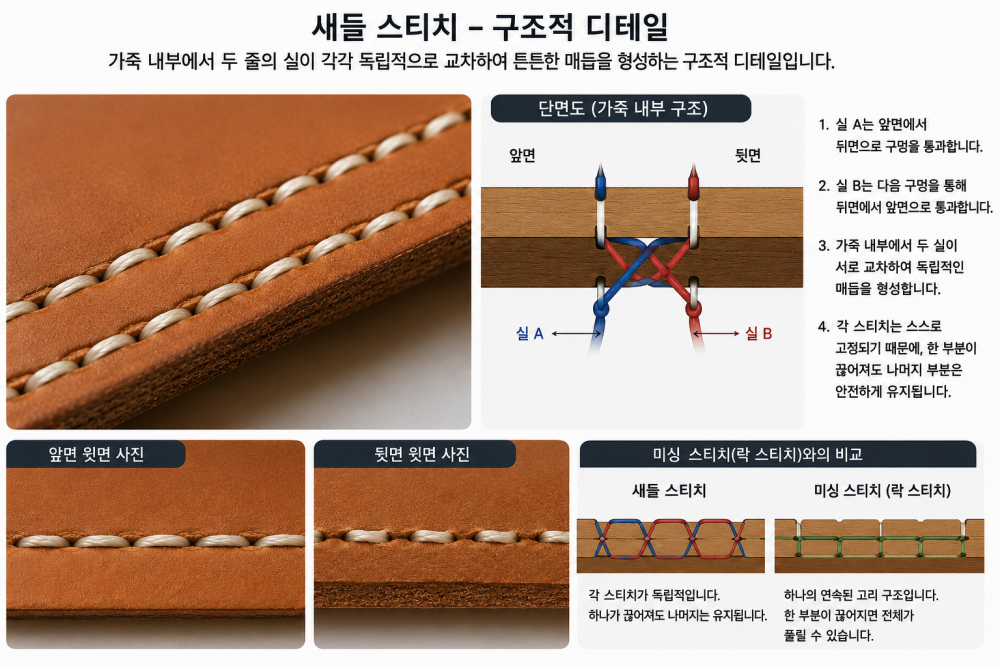
일반적인 재봉틀(미싱)바느질은 윗실과 아랫실이 가죽 중간에서 서로 고리를 걸어 당기는 구조입니다. 만약 이 구조에서 실 한곳이 끊어지면 도미노처럼 앞뒤의 실들이 연쇄적으로 풀려버리는 치명적인 약점을 가집니다
반면 에르메스를 비롯한 하이엔드 공방에서 고집하는 새들스티치는 하나의 실 양끝에 두개의 바늘을 꿰어 가죽의 타공 구멍 안에서 두줄의 실이 완벽하게 교차(X자 형태)하며 나아갑니다. 이는 한쪽 실이 마찰로 인해 끊어지더라도 반대편에서 넘어온 다른 실이 구멍 속에서 매듭을 꽉 붙잡아주기 때문에 바느질선이 결코 쉽게 풀리지 않습니다. 혹독한 환경을 견뎌야 하는 말의 안장(Saddle)을 만들때 쓰이던 기술인 만큼, 대를 이어 물려 쓸 수 있는 내구성의 주춧돌이 바로 이 새들스티치입니다.
2. 프랑스 린카블레(Lin Cable)실과 최고급 가죽이 만날때
훌륭한 바느질은 소재에 대한 깊은 이해에서 출발합니다. 가죽의 텍스처와 완벽한 조화를 이루는 실을 선택하는 것 또한 전문가의 감각영역입니다.
제가 프랑스산 크리스페 고트스킨이나 최고급 유럽산 가죽을 다룰때 언제나 곁에 두는 실이 있습니다. 바로 프랑스의 오랜 전통을 자랑하는 천연 리넨사, ‘린카블레(Lin Cable)입니다. 나일론이나 폴리에스테르 같은 화확 섬유실은 장력이 강하고 매끄럽지만, 시간이 흐를수록 천연가죽 특유의 유연한 에이징(Aging)속도를 따라가지 못해 가죽을 파고들거나 홀로 겉도는 이질감을 주곤합니다.
반면 린카블레는 천연 마(Lin)를 정밀하게 꼬아 밀랍(Waxing)을 입힌 실로, 바늘을 통과할 때 가죽 단면에 부드럽게 안착합니다. 특히 조직이 유연하면서도 짱짱한 프랑스 코트스킨의 타공 땀에 실이 스며들때, 천연소재끼리 맛물리며 생기는 특유의 견고함과 은은한 광택은 화확섬유가 결코 흉내 낼 수 없는 깊이를 선사합니다. 시간이 흐를수록 가죽과 함께 낡아가며 멋을 더하는것, 그것이 명품의 실이 가져야할 미덕입니다.
3. 20년 경력자가 말하는 가죽 두께별 밀리미터(mm)장력조절법
새들스티치를 할 때 흔히 하는 실수는 무조건 실을 강하게 잡아당기는 것입니다 양손의 장력을 제어하지 못하면 사선 모양이 비뚤어지거나 가죽면이 쭈글쭈글하게 우는 대참사가 발생합니다. 20년의 세월 동안 몸으로 체득한 실전 장력 조절의 핵심 기준은 다음과 같습니다
그리프(목타)땀수와 실 두께의 조화 : 정밀한 소품이나 슬림한 지갑류를 제작할 때는 보통 3.38mm(화란 규격 8호 그리프를 사용하며, 실 역시 린카블레 532나 632 같은 얇은 규격을 매칭합니다. 반면 두꺼운 가방류는 3.85mm나 4.0mm땀수에 린카블레 432를 매칭하여 시각적 안정감을 줍니다
가죽 두께에 따른 양손의 밀당 : 피할을 거쳐 0.6mm~0.8mm 수준으로 슬림해진 내부 포켓부위를 바느질 할때는, 평소 장력의 60~70% 감각으로 실을 부드럽게 놓아주듯 당겨야 가죽이 쪼그라들지 않습니다. 반대로 1.5mm 이상의 본판 가죽과 보강재가 겹쳐진 단단한 부위는 양손의 힘을 균일하게 100%로 주어 실이 가죽 안착점에 정확히 파고들도록 ‘착’감기는 느낌으로 당겨주어야 합니다.
이 손끝의 미세한 장력 차이가 실의 흐름을 일정하게 만들고, 제품 전체의 실루엣을 단단하게 잡아주는 결정적 디테일이 됩니다
4. 전문가의 감각을 그대로 옮긴 도면 자료실
새들스티치의 올곧은 사선 궤적은 결국 완벽한 타공에서 시작되며, 그 타공은 도면(패턴)의 정밀함에서 출발합니다. 바느질이 들어갈 치수와 가국이 접히는 곡률을 계산하지 않은 도안은 바느질 땀수를 어긋나게 만들고, 결국 장력을 아무리 조절해도 극복할 수 없는 구조적 한계를 만듭니다.
오직 자와 송곳으로 가죽의 수축률과 두께, 그리고 바느질 한 땀의 오차까지 역학적으로 계산해 낸 오리지널 수동 패턴은 제작자에게 완벽한 바느질 가이드라인이 되어줍니다.
단순한 도안을 넘어 실전 제작 프로세스의 메커니즘을 100% 반영하여 설계된 ‘예각 스타일 오리지널 패턴 PDF’는 글로벌 가죽 공예인들이 바느질의 실패없이 완벽한 사선 실루엣을 구현할 수 있도록 돕는 최고의 맵(Map)이 될 것입니다. 손끝의 장력이 만드는 한땀의 가치, 그 견고한 장인 정신의 세계를 곧 공개될 도면 자료실에서 직접 확인해 보시기 바랍니다.