Those who have not deeply experienced leather crafting often think of stitching as simply a finishing act to connect cut pieces of leather. They might ask if it really matters whether it is stitched rapidly by a sewing machine or sewn stitch by stitch by an artisan's hands, as long as the resulting thread line looks beautiful on the surface.
However, from the perspective of high-end leather engineering, stitching is not a mere combination. It is a "Structural Engineering" technique that determines the lifespan of a leather product. Today, we will explore the scientific reasons why traditional high-end leather workshops still insist on the "Saddle Stitch," a method dating back centuries, by looking closely at its structural differences from machine sewing.
1. What is the Saddle Stitch?
Definition and History
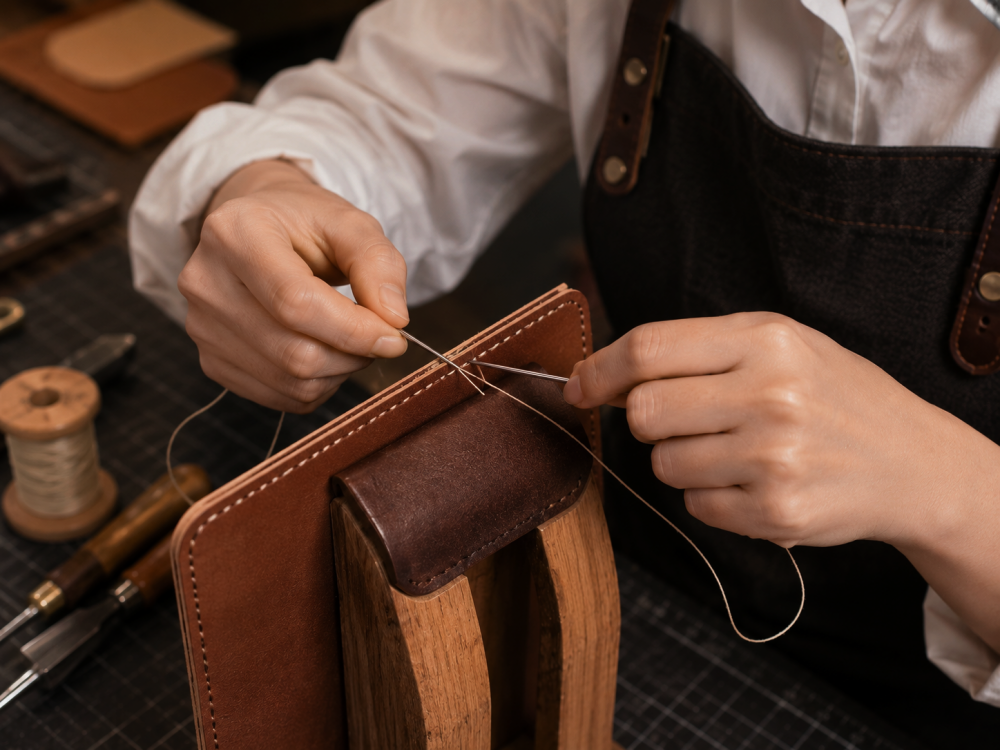
The saddle stitch, as the name suggests, is a traditional hand-stitching technique originally used when making a horse's "Saddle." It involves connecting a needle to each end of a single thread, utilizing a total of two needles to cross both threads through a single punched hole. A saddle had to fully withstand the rough movements of a horse and the weight of the rider, which meant it required the toughest and most durable structure humanly conceivable.
Why is it Still Used in High-End Bags?
No matter how much cutting-edge computer sewing machines have developed today, the reason traditional high-end workshops insist on this demanding hand-stitching method is simple. It is due to its "independent durability" that machines can never replicate, combined with the refined proportional beauty unique to handwork. ..
2. The Critical Structural Difference Between Machine and Hand Stitching
o understand the difference between machine sewing and the saddle stitch, we must examine the "structure of the knot" and how the threads interlock inside the leather layers.
| Category | Lock Stitch | Saddle Stitch |
| Number of Threads | Top and bottom threads (2 different threads) | Two needles on a single thread (1 continuous thread) |
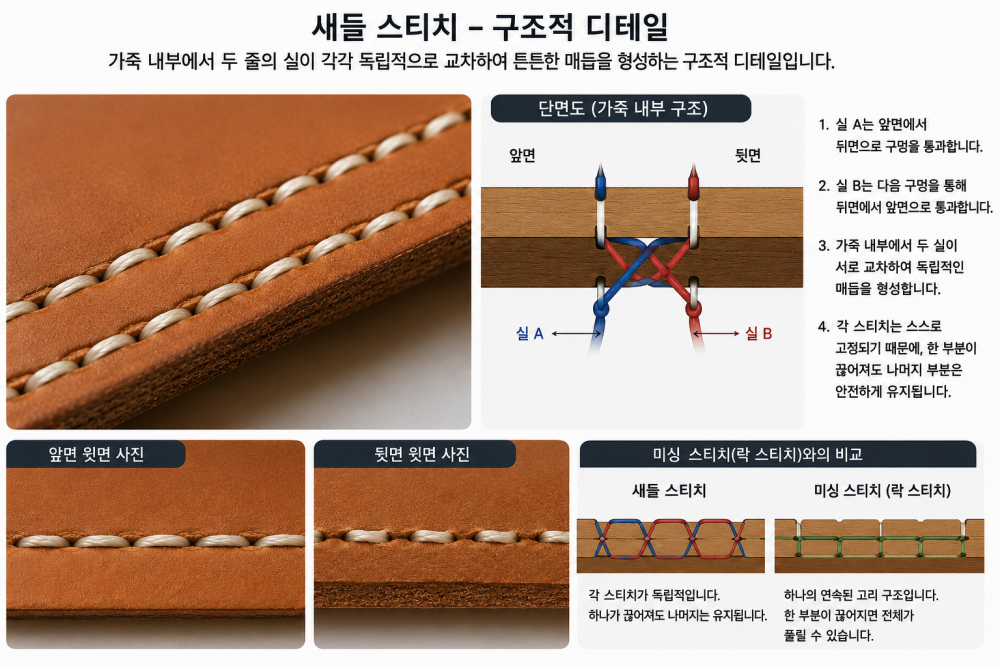
| Interlocking Method | Threads simply loop and twist past each other inside the leather | Two threads completely cross and knot over each other inside the hole |
| Tensile Stress | If one part breaks, it unravels like dominoes | If one part breaks, the oppositethread maintains the structure |
The Limitation of Machines: The Lock Stitch
A sewing machine works by having the top thread pierce through the leather to catch the bottom thread like a loop, pulling it back up. In other words, the two threads are merely "loosely hooked" to each other inside the leather. This structure has a fatal weakness. The moment a single stitch is severed due to friction, the tension holding the upper and lower threads is lost, causing three or four stitches to completely unravel in a domino effect.
The Strength of Handwork: The Saddle Stitch
On the other hand, the saddle stitch allows two lines of thread to cross perfectly in forward and reverse directions within a single hole. It forms a shape where the thread wraps tightly around the inside and outside of the leather like a Möbius strip. This structural difference dictates the lifespan of the bag.
3. Why is the Saddle Stitch More Durable? The Scientific Principle
The Principle of Independently Secured Threads
Every time the saddle stitch passes through a leather hole, the threads form a knot as they move over. Because the two threads are tightly twisted by strong friction inside the leather, each individual stitch is secured as an entirely independent unit.
The Difference When One Thread Breaks
Suppose a bag has been used for years, and one line of thread on a high-friction corner finally wears down and breaks.
- A machine-sewn bag unravels, the leather gap opens up, and the internal reinforcement materials become exposed.
- In contrast, a saddle-stitched bag remains secure. The other line of thread coming from the opposite side continues to hold the leather together tightly, maintaining its tension thanks to the twisted structure inside the hole. This is the scientific secret that allows hand-stitched bags to be passed down through generations.
4. Why an Artisan Chooses the Saddle Stitch Over Machines
Durability
Thanks to the structural resilience mentioned above, it perfectly withstands intense friction and the tensile stress caused by the weight of internal belongings.
Repairability
When a machine-sewn bag unravels, the entire line of stitching must often be ripped out and resewn from the beginning to look neat. In contrast, a saddle stitch allows for partial repairs (Après-vente), seamlessly blending a few new stitches exactly where the thread broke.
Aesthetics
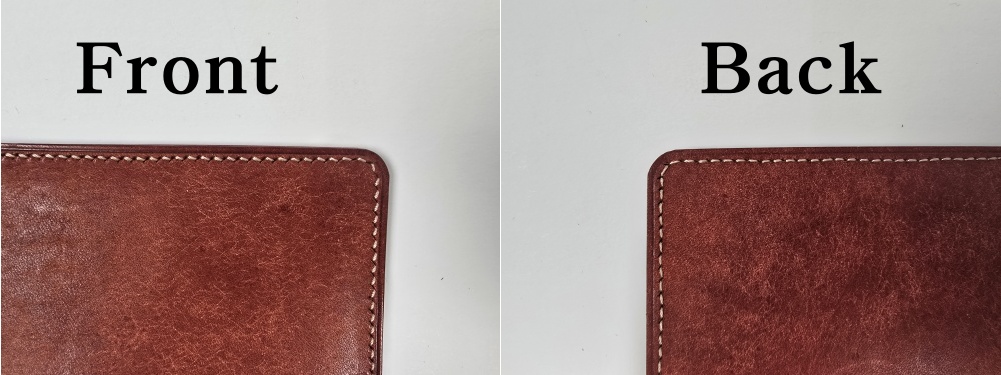
Driven by the consistent tension of an artisan's hands along the pricking iron marks, the thread creates a flowing, three-dimensional diagonal slant that no machine can match. The symmetrical beauty between the front and back sides makes it a work of art in its own right.
5. YEGAK's Standards: An Obsession with Structural Perfection
At YEGAK, we reject stitching that serves as mere visual decoration. We only permit precise stitches that calculate the density of the hidden inner walls and reinforcement materials of the bag.
- Thread Selection: Instead of the artificial gloss provided by synthetic threads (polyester), we insist exclusively on premium natural French linen thread. It ages beautifully alongside the leather, settling deep into the leather fibers over time.
- Stitch Spacing: Depending on the size of the bag, the thickness of the leather, and the combination of reinforcements, we specify the exact stitch count during the manual pattern design phase, ranging from size 7 (3.85mm) to size 9 (3.0mm). If it is excessively dense, the leather will tear; if it is too wide, the structural stability compromises.
- Needle Selection: We carefully select and use premium British saddle needles with rounded, precisely finished tips to ensure they glide smoothly through the leather fibers without forcefully tearing the internal structure.
6. Conclusion
"Saddle Stitch is not simply a sewing method. It is a structural engineering technique that determines the lifespan of a leather product."
Slow but solid—crossing two needles to fill a single stitch takes dozens of times longer than a machine. However, that density of time becomes the lifespan of the bag, and it is the value YEGAK refuses to compromise on.
In the next chapter, we will take an engineering approach to the foundation of the saddle stitch: "The Differences in Tensile Strength and Aging Between Natural Linen Thread and Polyester Thread."
Leave a Reply