Tag: Structural Integrity

  • Why Proportion Defines Luxury: The Science of Golden Ratios in Bag Pattern Engineering

    There is a common fallacy among many who visit leather ateliers. When they encounter a stunning bag, they often remain suspended in abstract admiration, remarking that the artisan has "excellent sense" or that the design is simply "sophisticated." They fail to see the true secret hidden behind the vague concept of artistic intuition.

    However, in the elite realm of high-end bag construction, beauty is never a product of chance. A masterpiece that transcends fleeting trends and projects a profound sense of stability for decades is the direct result of rigorous calculation and mathematical proportion. Great design does not spring from innate sense; it begins with cold, calculated precision, agonizing over dimensions with a ruler in hand.


    1. More Than Just a Drawing

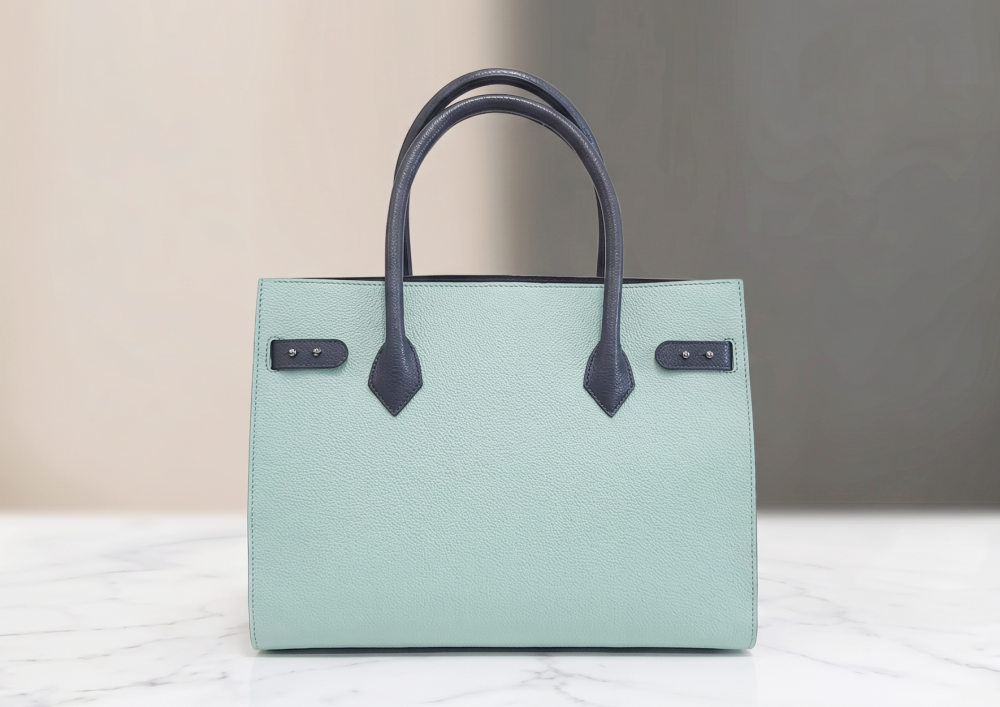
    When you closely observe the high-end bags we call luxury items, the dimensions and positioning of their components align with astonishing neatness. The depth of the flap in relation to the main body, the spacing where the handles are anchored, and the width of the gusset all sustain a state of perfect equilibrium.

    If you begin drafting based purely on visual sense, the silhouette of the bag will drift with every build, or you will fail to erase a subtle, awkward clumsiness. This is exactly why you must calculate the proportion and balance of every single element before drawing a line. Flawless proportion is the foundational engineering formula that eliminates visual chaos and maximizes the inherent majesty of the material.


    2. Structural Integrity

    The human eye instinctively searches for visual balance, and the pinnacle of that harmony is the Golden Ratio (1:1.618). From ancient temples to modern smartphones, this proportion instills a sense of stability because the laws of natural growth and the mechanics of three-dimensional volumetric structures find perfect harmony within this specific ratio.

    When engineering a bag, the Golden Ratio is not merely applied to a flat, two-dimensional rectangle. It serves as the metric that anchors the visual center of gravity within the three-dimensional structural architecture where the front panel, gusset, and base intersect. A bag engineered upon the Golden Ratio maintains a comfortable, volumetric balance—not just when viewed from the front, but also from an oblique angle or when the user looks down from above—ensuring the eye never drifts unevenly.

    3. The Dynamics of Tolerances

    When drafting a pattern, the critical component proportions that must be strictly controlled through structural engineering are as follows:

    • Height-to-Width Ratio: This is the primary structural framework that dictates the first impression of a bag. If the golden proportion of the front rectangle collapses, the bag will appear heavy and dull, or conversely, overly narrow and structurally unstable.
    • Handle Placement and Spacing: The vertical proportion of the silhouette alters drastically depending on how far the handles migrate from the central axis of the main body. Handles spaced too far apart cause the form to appear sprawled, while handles set too close together make it look visually constricted.
    • Flap Length: For bags utilizing a closure flap, the critical variable is exactly what fraction of the total front height the flap occupies as it descends. If this ratio drifts, the visual center of gravity shifts entirely, making the bag look top-heavy or sagging downward.
    • Base Width and Gusset Ratio: The proportion of the base and gussets, which define the volumetric depth of the bag, must interlock organically with the surface area of the front panel. If the gusset is excessively wide relative to the front, the architectural balance breaks down entirely.
    4. The Mathematical Geometry of Curves

    Proportion is not a mere cosmetic plaything intended to create something visually pleasant. A layout with broken proportions inevitably yields physical and structural defects.

    For instance, if you draft the main body excessively tall simply because it looks modern, the internal payload hangs long vertically, stretching the leather downward and causing the structure to buckle prematurely. Conversely, if you assign an overly narrow base while extending the handles long, the center-of-gravity axis wobbles when lifted, concentrating intense tensile stress directly onto the joint seams.

    Ultimately, the load bottlenecks at a single point, causing the traditional hand-stitched seams to rupture or the leather to warp violently. In other words, exquisite proportion is synonymous with a state of mechanical optimization that distributes the load of the bag in the most ideal trajectory.


    5. Weight Distribution Mechanics

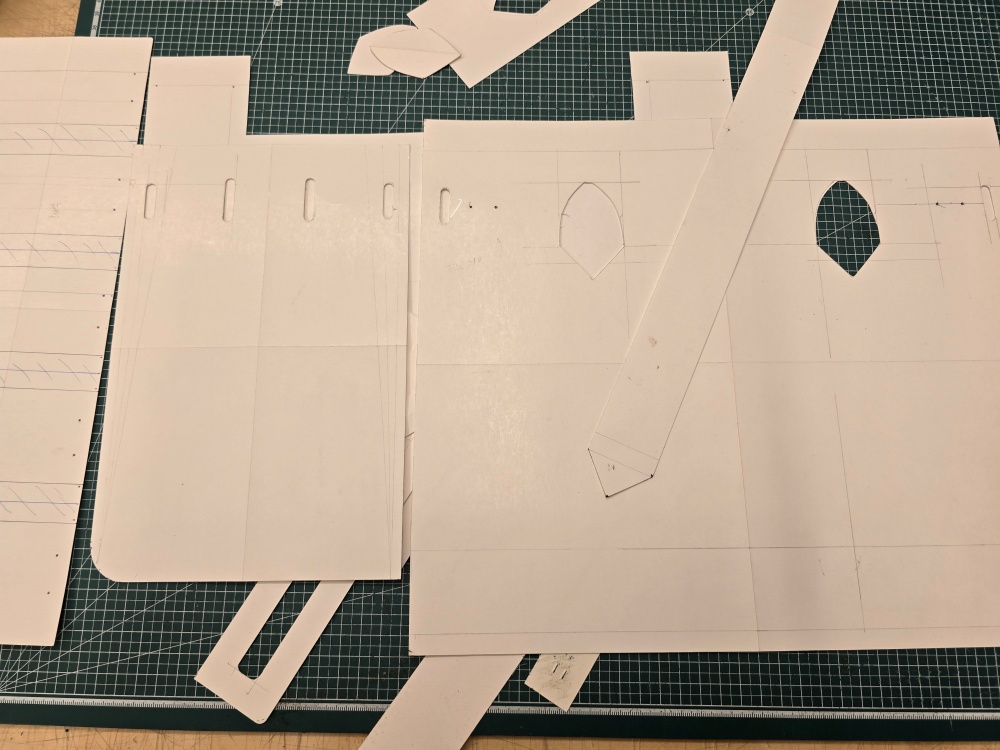
    When I am at the workbench drafting a new pattern, I never rush to draw specific lines first. Instead, I step back to visually distill the overarching proportion and volumetric mass of the bag onto the blank sheet, dividing the space mathematically before anything else.

    This is because a mere variance of 1cm, or even 5mm, completely transforms the entire presence of a bag. Expanding by 5mm reduces it to a crude utility sack; narrowing it by 5mm charges it with the sharp, crisp tension of a true luxury masterpiece. Refusing to mechanically draw along the grids of graph paper, controlling the exact proportions of the space where the leather will breathe down to fractions of a millimeter—this is the uncompromising authority and philosophy of YEGAK's manual pattern engineering.


    6. Conclusion

    A great pattern is never just a collection of flat lines drawn on paper to cut out leather. It is a predictive blueprint that anticipates and governs the future of the finished bag—calculating leather elasticity, reinforcement density, and the dispersal of gravity and load. Only a blueprint brought to perfection on paper through flawless proportion can withstand the test of time, yielding a masterpiece that confidently endures twenty years from now.


    7. The Uncompromising YEGAK Discipline

    • [Previous Step] Pattern Engineering: Why Great Bags Are Already Finished on Paper
    • [Next Up] Bag Reinforcement Engineering: Hidden Structures That Determine Durability
  • Pattern Engineering: Why Great Bags Are Already Finished on Paper

    For those who view leather crafting merely as a hobby, a pattern is often considered nothing more than a temporary drawing on paper used to cut leather. They tend to believe that by simply copying a pre-made commercial pattern, scratching the lines onto the hide with an awl, cutting it out, and stitching it together, a bag will effortlessly manifest.

    However, in the elite realm of high-end bag construction, a pattern is far more than a basic drawing. It is a highly sophisticated architectural blueprint that calculates and quantifies the exact thickness of the leather, the structural density of internal reinforcements, the physical tolerance during assembly, and the mechanical forces of gravity acting upon the finished form. In essence, a great bag is already finished on paper; its fate and structural integrity are determined long before a knife ever touches the leather


    1. More Than Just a Drawing

    Pattern engineering is deeply rooted in architecture rather than art. It is a precise mathematical discipline where flat sheets of heavy paper are systematically drafted and combined to ensure that when the exterior shell and internal reinforcements are physically joined, they sustain a flawless three-dimensional volumetric structure.

    Leather is a "living, organic medium"—its fiber orientation, shrinkage rates across different sections, and structural plasticity when introduced to moisture vary constantly. A pattern drafted solely by visual dimensions, without calculating these volatile physical parameters, will never achieve the caliber of a true masterpiece, regardless of how premium the leather is or how precise the saddle stitching appears on the surface.


    2. Structural Integrity

    When a bag prematurely sags or deforms over time, most crafters quickly blame the choice of internal reinforcements or uneven thread tension. However, the fundamental root of structural failure almost always traces back to the drafting phase—specifically, the failure to calculate material displacement during three-dimensional assembly.

    When the exterior leather, internal lining, and rigid reinforcements are layered and bent along a curve, the inner layers must structurally be shorter than the outermost layer. If this microscopic dimensional balance is not tightly controlled on paper down to fractions of a millimeter, the leather will buckle or warp the second the panels are bonded. The crisp lines, proportion, and self-standing majesty of a bag must be absolute on the pattern before assembly begins.

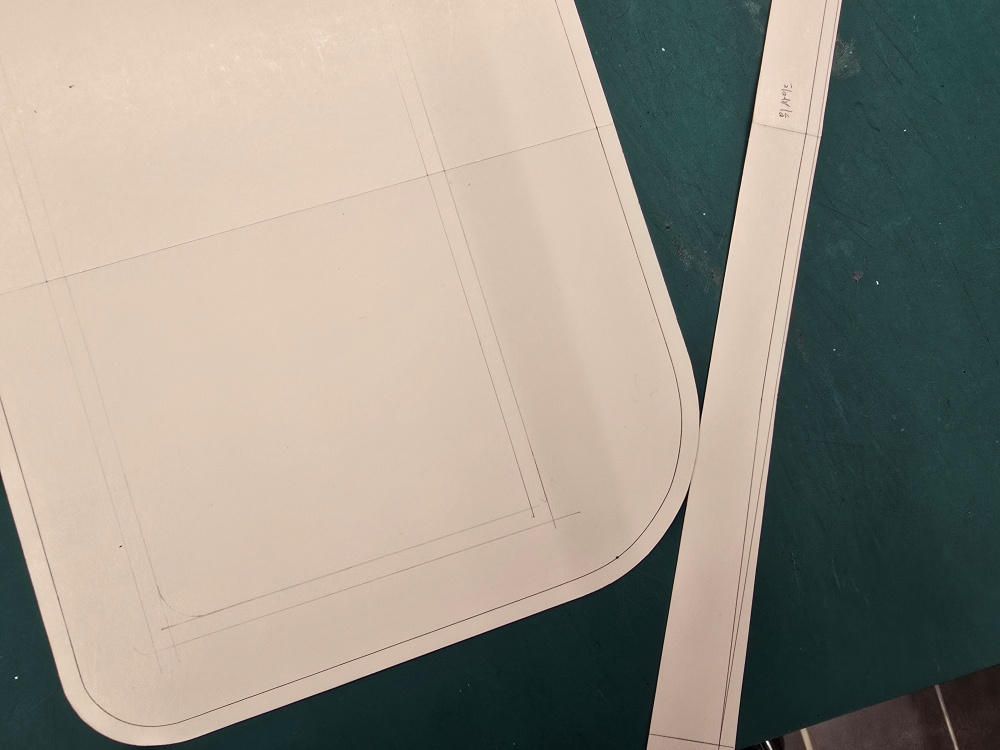
    모눈종이를 쓰지 않고 직접 직선과 십자 패턴 축을 세우며 정밀하게 가방 도안을 설계하는 장인의 작업대 전경

    3. The Dynamics of Tolerances (Seam Allowance)

    The most catastrophic structural dimensional errors occur within the calculation of seam allowances. As the physical thickness of the leather substrate increases, the geometric gap between the expanding outer circumference and the compressing inner radius widens drastically whenever panels intersect.

    When drafting a pattern by hand, a master artisan carefully calculates the specific thickness of the exterior leather, the density of the lining, and even the microscopic volume of the adhesive layers to assign unique skiving margins and seam allowances to each separate panel. If these intricate calculations are slightly off, the entire layout drifts, causing stitching lines to warp diagonally or rendering structural assembly physically impossible.

    가죽 두께와 보강재 결합 오차를 계산하여 종이 패턴 위에 소수점 단위로 여유분(시접)을 표시한 설계도 상세 사진

    4. The Mathematical Geometry of Curves

    The sweeping, elegant corner arches that define a luxury silhouette or the radical contours of an inverted gusset cannot be accurately generated with basic flat rulers.

    Even if a curved line and a straight line measure exactly the same length on a flat surface, when they are manipulated into a three-dimensional plane, the leather fibers along the curve compress or stretch, altering the true mating length. Rejecting standard grid papers, YEGAK utilizes manual axial and cross-pattern drafting techniques to thoroughly simulate the physical resistance at the precise intersections of radii (R-values) directly on the paper, achieving an absolute mechanical match.

    가방 옆판의 입체 곡선과 본체의 직선이 만나는 지점의 물리적 저항을 종이 패턴을 맞대어 정밀하게 검수하는 과정

    5. Weight Distribution Mechanics (Center of Gravity)

    A flawlessly engineered bag maintains its clean geometric profile even when loaded to capacity, ensuring that the mass does not awkwardly lean or shift when held by the handles. This represents the pinnacle of pattern engineering: Center of Gravity Architecture.

    The exact mounting angle of the handles, the surface area of the attachment lugs, and the precise boundaries of the bottom base reinforcements must be calculated to strategically distribute stress. A pattern with flawed center-of-gravity engineering will tilt forward or backward when lifted, concentrating intense tensile stress onto a single joint, causing the structural thread lines to rupture and the leather to permanently deform.

    가방 손잡이 장착 부위의 하중 분산 메커니즘과 무게 중심축을 종이 위에 정밀한 선으로 구획한 패턴 설계 레이아웃

    6. The Inevitability of Poor Design

    Even if a crafter possesses decades of hands-on experience at the workbench, a flawed pattern forces them to forcefully stretch, pull, or cram the leather during assembly to make the edges meet. A bag built under artificial structural stress may look passable on day one, but over time, the inherent elastic memory of the leather will violently pull back toward its true state, causing the entire bag to buckle and sag inward.

    To build a true long-term asset that confidently endures for over twenty years, an artisan must never rely on temporary sensory adjustments to coerce the leather. Instead, the material must be guided to rest completely naturally within the absolute, mathematically verified dimensions of an engineered pattern.


    7. The Uncompromising YEGAK Discipline

    YEGAK strongly rejects over-reliance on digital CAD printouts or highly standardized commercial grid papers. Cold, automated lines can never truly capture or account for the organic elasticity, grain resistance, and nuances of a living hide.

    Erecting the primary axes and strict perpendicular guidelines directly by hand, projecting the volumetric density of leather and reinforcements onto the raw paper—this is the very essence of the "slow but solid" pattern engineering philosophy that YEGAK safeguards. Controlling a 0.1mm gap on a sheet of draft paper is the absolute boundary that segregates fine art from commercial mass production.


    Next Level: The YEGAK Knowledge Graph

    • [Previous Step] Thread Tension and Material Resistance: The Structural Equation of the Traditional Saddle Stitch
    • [Next Up] Thread Character and the Function of Aging: Natural Linen Thread vs. Polyester Thread

  • The Science of Saddle Stitch: Why Hand Stitching Outlasts Machine Stitching

    Those who have not deeply experienced leather crafting often think of stitching as simply a finishing act to connect cut pieces of leather. They might ask if it really matters whether it is stitched rapidly by a sewing machine or sewn stitch by stitch by an artisan's hands, as long as the resulting thread line looks beautiful on the surface.

    However, from the perspective of high-end leather engineering, stitching is not a mere combination. It is a "Structural Engineering" technique that determines the lifespan of a leather product. Today, we will explore the scientific reasons why traditional high-end leather workshops still insist on the "Saddle Stitch," a method dating back centuries, by looking closely at its structural differences from machine sewing.

    1. What is the Saddle Stitch?

    Definition and History

    The saddle stitch, as the name suggests, is a traditional hand-stitching technique originally used when making a horse's "Saddle." It involves connecting a needle to each end of a single thread, utilizing a total of two needles to cross both threads through a single punched hole. A saddle had to fully withstand the rough movements of a horse and the weight of the rider, which meant it required the toughest and most durable structure humanly conceivable.

    Why is it Still Used in High-End Bags?

    No matter how much cutting-edge computer sewing machines have developed today, the reason traditional high-end workshops insist on this demanding hand-stitching method is simple. It is due to its "independent durability" that machines can never replicate, combined with the refined proportional beauty unique to handwork. ..

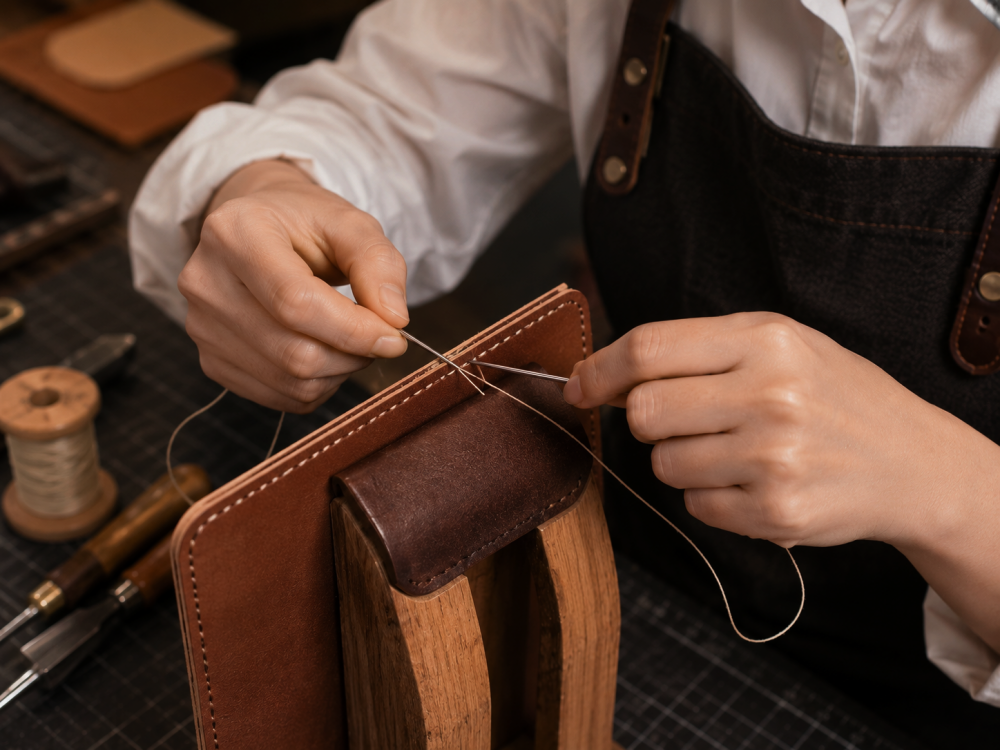
    두 개의 바늘과 린넨 실을 이용하여 포니 위에서 정밀하게 새들 스티치를 구현하는 장인의 손길)

    2. The Critical Structural Difference Between Machine and Hand Stitching

    o understand the difference between machine sewing and the saddle stitch, we must examine the "structure of the knot" and how the threads interlock inside the leather layers.

    CategoryLock StitchSaddle Stitch
    Number of ThreadsTop and bottom threads (2 different threads)Two needles on a single thread (1 continuous thread)
    Interlocking MethodThreads simply loop and twist past each other inside the leatherTwo threads completely cross and knot over each other inside the hole
    Tensile StressIf one part breaks, it unravels like dominoesIf one part breaks, the oppositethread maintains the structure

    The Limitation of Machines: The Lock Stitch

    A sewing machine works by having the top thread pierce through the leather to catch the bottom thread like a loop, pulling it back up. In other words, the two threads are merely "loosely hooked" to each other inside the leather. This structure has a fatal weakness. The moment a single stitch is severed due to friction, the tension holding the upper and lower threads is lost, causing three or four stitches to completely unravel in a domino effect.

    The Strength of Handwork: The Saddle Stitch

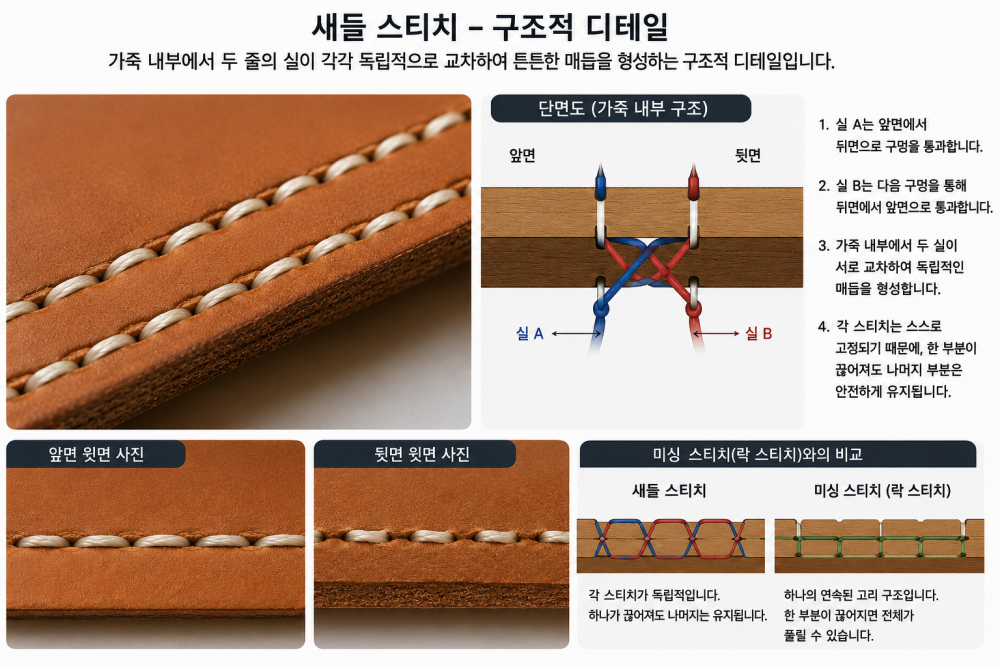
    On the other hand, the saddle stitch allows two lines of thread to cross perfectly in forward and reverse directions within a single hole. It forms a shape where the thread wraps tightly around the inside and outside of the leather like a Möbius strip. This structural difference dictates the lifespan of the bag.

    3. Why is the Saddle Stitch More Durable? The Scientific Principle

    The Principle of Independently Secured Threads

    Every time the saddle stitch passes through a leather hole, the threads form a knot as they move over. Because the two threads are tightly twisted by strong friction inside the leather, each individual stitch is secured as an entirely independent unit.

    The Difference When One Thread Breaks

    Suppose a bag has been used for years, and one line of thread on a high-friction corner finally wears down and breaks.

    • A machine-sewn bag unravels, the leather gap opens up, and the internal reinforcement materials become exposed.
    • In contrast, a saddle-stitched bag remains secure. The other line of thread coming from the opposite side continues to hold the leather together tightly, maintaining its tension thanks to the twisted structure inside the hole. This is the scientific secret that allows hand-stitched bags to be passed down through generations.
    가죽 내부에서 두 줄의 실이 독립적으로 교차하며 견고한 매듭을 형성하는 구조적 디테일

    4. Why an Artisan Chooses the Saddle Stitch Over Machines

    Durability

    Thanks to the structural resilience mentioned above, it perfectly withstands intense friction and the tensile stress caused by the weight of internal belongings.

    Repairability

    When a machine-sewn bag unravels, the entire line of stitching must often be ripped out and resewn from the beginning to look neat. In contrast, a saddle stitch allows for partial repairs (Après-vente), seamlessly blending a few new stitches exactly where the thread broke.

    Aesthetics

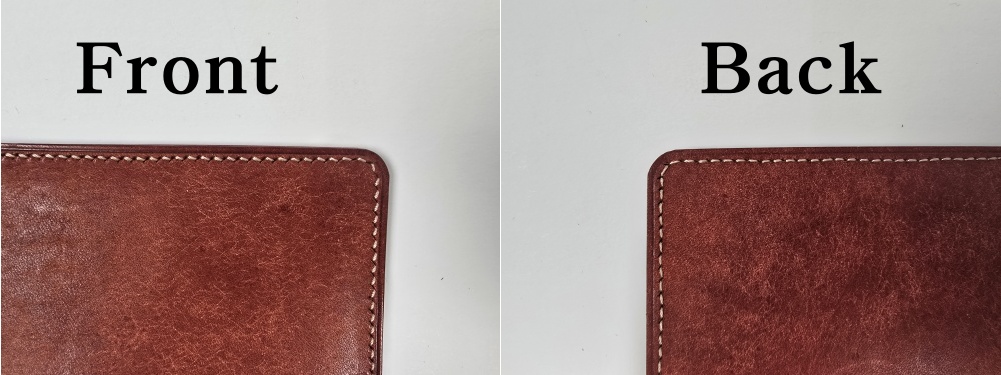
    Driven by the consistent tension of an artisan's hands along the pricking iron marks, the thread creates a flowing, three-dimensional diagonal slant that no machine can match. The symmetrical beauty between the front and back sides makes it a work of art in its own right.

    앞면 : 사선 그리프 자리를 따라 칼같이 일정한 각도로 정렬된 새들 스티치 앞면의 유려한 사선 흐름뒷면 : 앞면과 완벽한 대칭을 이루며 한 치의 흐트러짐 없이 견고하게 마감된 새들 스티치 뒷면 라인)

    5. YEGAK's Standards: An Obsession with Structural Perfection

    At YEGAK, we reject stitching that serves as mere visual decoration. We only permit precise stitches that calculate the density of the hidden inner walls and reinforcement materials of the bag.

    • Thread Selection: Instead of the artificial gloss provided by synthetic threads (polyester), we insist exclusively on premium natural French linen thread. It ages beautifully alongside the leather, settling deep into the leather fibers over time.
    • Stitch Spacing: Depending on the size of the bag, the thickness of the leather, and the combination of reinforcements, we specify the exact stitch count during the manual pattern design phase, ranging from size 7 (3.85mm) to size 9 (3.0mm). If it is excessively dense, the leather will tear; if it is too wide, the structural stability compromises.
    • Needle Selection: We carefully select and use premium British saddle needles with rounded, precisely finished tips to ensure they glide smoothly through the leather fibers without forcefully tearing the internal structure.

    6. Conclusion

    "Saddle Stitch is not simply a sewing method. It is a structural engineering technique that determines the lifespan of a leather product."

    Slow but solid—crossing two needles to fill a single stitch takes dozens of times longer than a machine. However, that density of time becomes the lifespan of the bag, and it is the value YEGAK refuses to compromise on.

    In the next chapter, we will take an engineering approach to the foundation of the saddle stitch: "The Differences in Tensile Strength and Aging Between Natural Linen Thread and Polyester Thread."