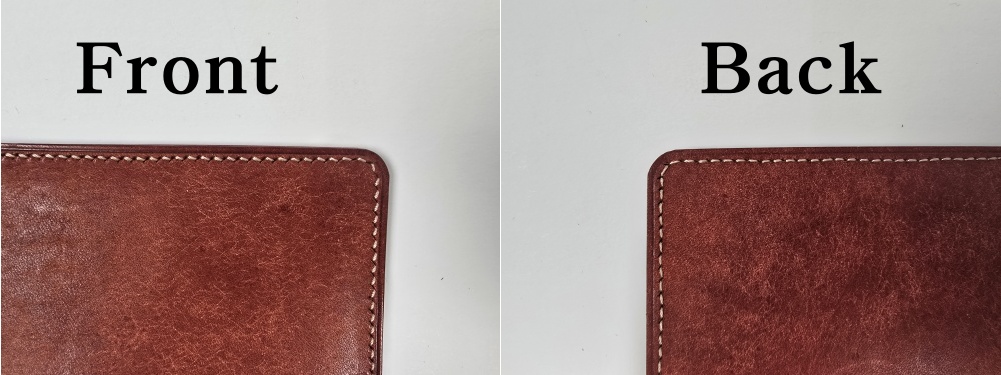
Tag: Saddle Stitch

  • 가죽공예 실 굵기와 목타 간격의 관계: 스티치 비례가 완성도를 결정한다

    The Relationship Between Leathercraft Thread Thickness and Chisel Spacing: Stitch Proportions Determine the Final Quality

    In leathercraft, thread is not simply a material for connecting pieces of leather. The thickness of the thread and the spacing of the stitches change the impression and balance of the bag, determining how refined the finished piece looks.

    Even with the same leather and the same pattern, the stitches can look delicate, overly heavy, or sparse depending on which thread and chisel you choose.

    To create good stitches, you shouldn't just choose the thread thickness; you must judge the chisel spacing, leather thickness, and the size of the piece as a single proportion.
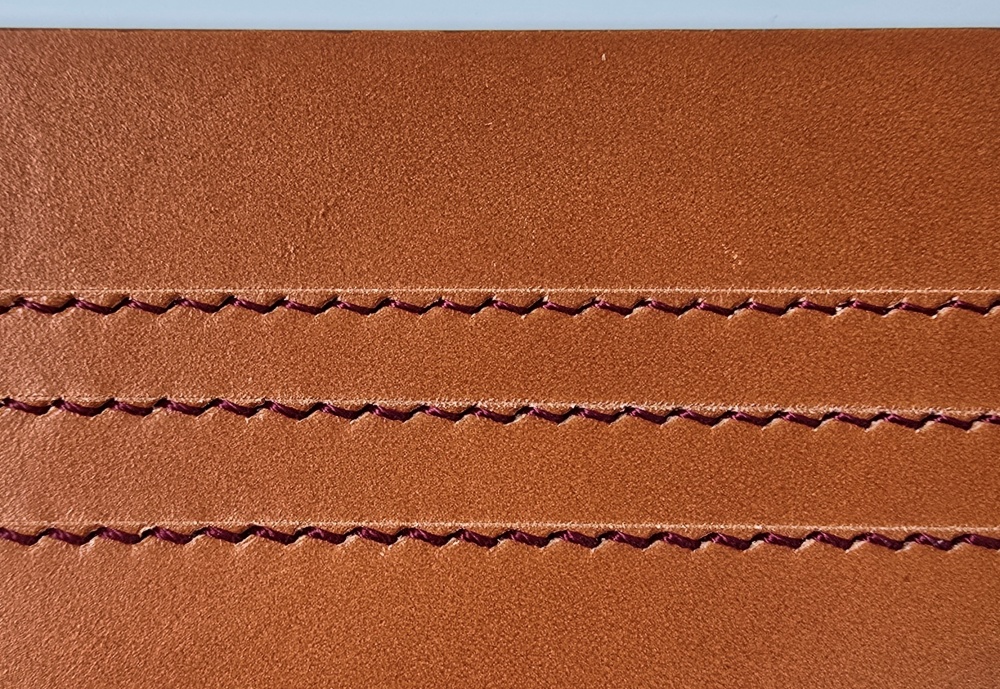
    같은 목타 간격에서 실 굵기를 달리한 가죽 스티치 비교

    Thread Thickness Cannot Be Chosen in Isolation

    Using a thick thread makes the stitches look distinct and gives them a strong presence. However, if only the thread becomes thicker while the chisel spacing remains narrow, the stitches may push against each other, looking cramped, or the area around the holes may be unnecessarily emphasized.

    Conversely, a thin thread creates a delicate and calm impression, but if the chisel spacing is too wide, the stitch line may appear disconnected or give an impression of lacking strength compared to the size of the piece.

    Thread is not necessarily more luxurious just because it's thicker, nor more precise just because it's thinner. The most appropriate thread is the one that naturally suits the size of the piece, the thickness of the leather, and the stitch spacing.

    When choosing a thread, you should first look at the proportion the thread will occupy at the edge of the leather after stitching, rather than the thickness of the thread itself.

    Chisel Spacing Creates the Rhythm of the Stitches

    Chisel spacing determines the speed and rhythm at which the stitches are repeated. If the spacing is narrow, the stitches become dense, creating a delicate impression. If the spacing is wide, each stitch becomes clearly visible, creating a more relaxed and powerful atmosphere.

    Characteristics of Narrow Chisel Spacing

    • It suits small items like small wallets or cardholders well.
    • It is great for creating a refined impression when using thin leather and relatively thin thread.
    • Using it with thick thread can make the stitches overly dense.

    Characteristics of Wide Chisel Spacing

    • It suits large and structural parts like bags or handles well.
    • When combined with a moderately thick thread, it can highlight the presence of the stitches.
    • Using a thread that is too thin can make the spaces between the stitches look empty.
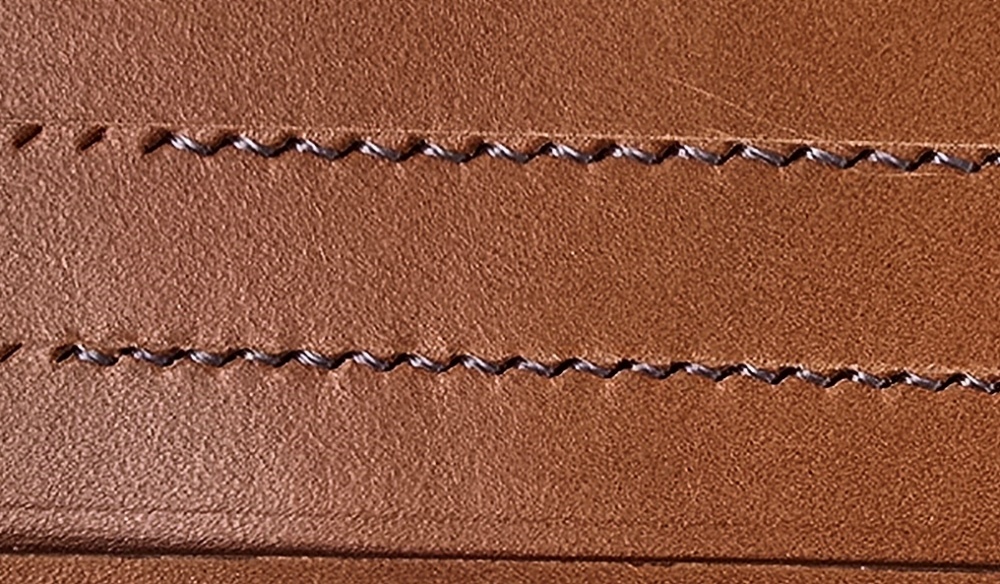
    같은 실을 사용하고 목타 간격을 달리한 가죽 스티치 비교

    Even if the indicated spacing of the chisel is the same, the actual impression of the stitches can vary depending on the shape of the blade, the size of the hole, and the angle at which the chisel is struck. Therefore, rather than choosing a chisel based solely on numbers, it is safer to confirm it through an actual test stitch.

    How to Understand Vinymo MBT Numbers and Thread Thickness

    Vinymo MBT is a thread I frequently use when making actual bags and accessories. The twist does not unravel easily, and the condition of the thread remains relatively stable during stitching, making it useful for repetitive work.

    For Vinymo MBT, the thread generally becomes thicker as the number gets smaller. For example, #8 is thinner than #5, and #1 is thicker than #5.

    However, you should not determine the thread based on the number alone. Even with the same number, the impression of the finished stitches can vary depending on the thread's color, wax treatment, pulling tension, and the needles and chisels used.

    The reason use Vinymo MBT more oftenis not simply because the thread is strong. It is because it is easy to predict the condition of the thread during work and good for maintaining a consistent balance in the finished stitches.
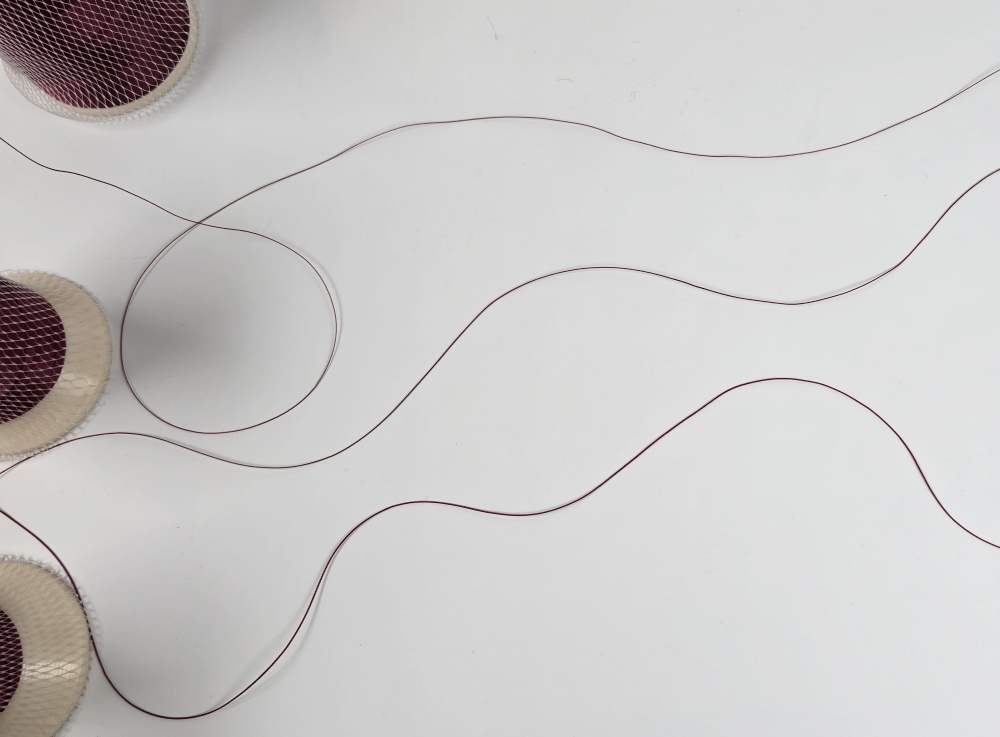
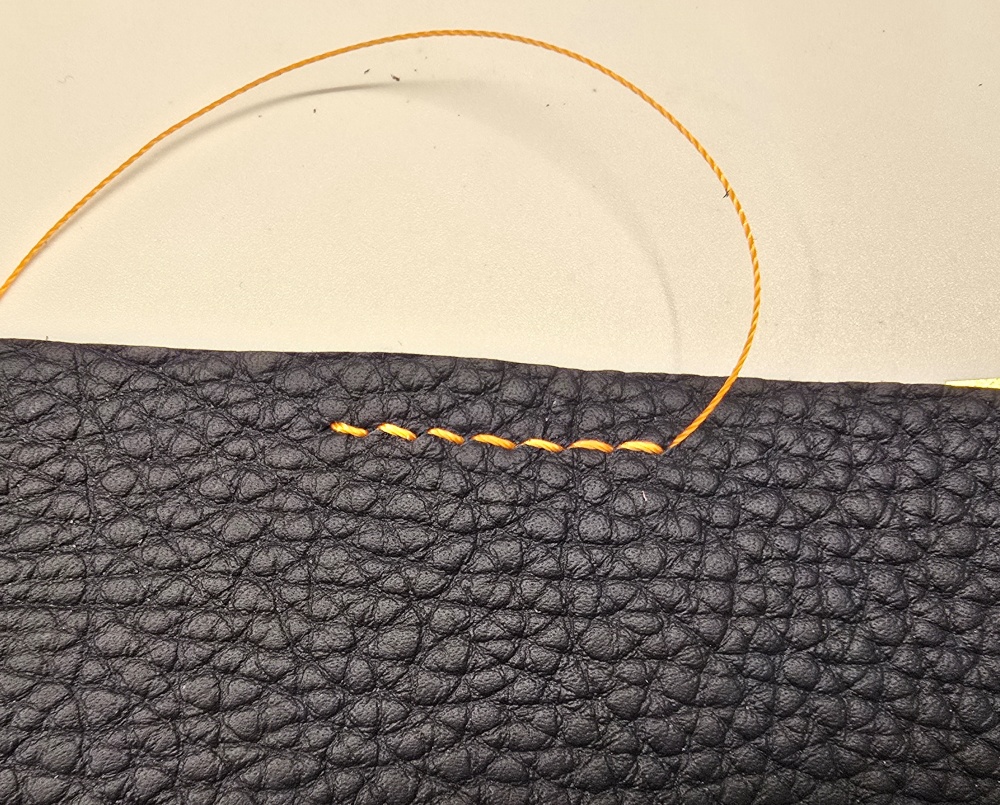
    굵기가 다른 비니모 MBT 실과 풀어 놓은 실 가닥

    Look at the Final Thickness, Not Just a Single Piece of Leather

    A common mistake when determining thread thickness is to only look at the thickness of a single piece of leather. However, in actual bag making, leather is often folded, reinforcements and linings are added, and multiple layers of leather are stacked.

    Therefore, when choosing a thread, you should judge based on the final thickness of the part to be stitched, not a single piece of cut leather.

    • How many layers of leather are stacked?
    • Are folded parts or reinforcements included?
    • Do the stitches play a role in holding the structure?
    • Are they stitches to be emphasized decoratively?
    • What is the overall size of the finished piece?

    If you choose a thick thread looking only at a single thin piece of leather, the stitches may become overly heavy in the finished stage. Conversely, using a thread that is too thin on thick handles or parts where multiple layers overlap can make the stitches look weak relative to the structure.

    Test Stitching is the Smallest Design Process

    Before striking the chisel directly on the finished product, it is advisable to do a test stitch on a scrap of the same leather. If possible, you should stack the same number of leather pieces as the actual production part and prepare the gluing and edge finishing similarly.

    During the test stitch, check the following items:

    • Is it too tight when the thread passes through the chisel hole?
    • Does the leather surface pucker or do the holes gape when the thread is pulled?
    • Is the angle of the stitches consistent on the front and back?
    • Is the thread thickness too strong or too weak compared to the size of the piece?
    • Does the spacing of the stitches connect naturally even on curved parts?

    You should also examine the relationship between the awl hole size and stitch qualityEven if the proportion of the thread and chisel is appropriate, if the holes are too large or inconsistent, the stitch line will not remain neat.
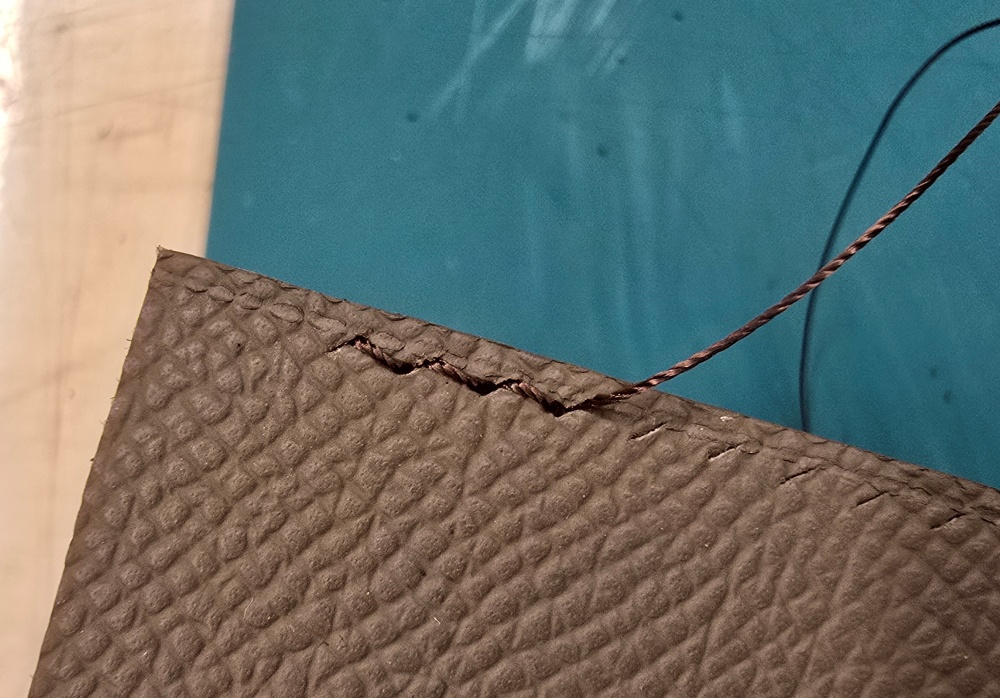
    가죽 자투리에 실 굵기와 목타 간격을 바꾸어 시험 바느질하는 모습

    Test stitching is not a process that wastes materials. It is a design process that discovers potential proportional errors in the finished product at the lowest cost.

    Adjusting the Presence of Stitches According to the Size of the Piece

    In small accessories, a single stitch takes up a large proportion of the overall design. Therefore, using relatively thin thread and narrow spacing is good for creating a delicate and calm impression.

    On the main body of a medium-sized bag, the thread and chisel should not be overly conspicuous while stably tidying up the leather edges. Here, it is important to look at the thickness of the leather and the location of the stitches together to find a medium proportion.

    For handles, strap connections, and outlines that emphasize structure, you can utilize relatively thick thread or wide spacing. However, since using thick thread does not necessarily increase durability, the size of the holes and the stitching tension must also be adjusted.

    Good Stitches Do Not Stand Out Before the Bag

    Refined stitches certainly elevate the perfection of a bag. However, if the stitches are revealed too strongly, the stitch line may be seen before the shape of the bag and the texture of the leather.

    Rather than showing off, good stitches tidy up the edges of the leather, follow the lines of the pattern, and quietly support the structure of the bag.

    Choosing thread thickness and chisel spacing is not a simple material selection, but a process of designing the proportions of the entire bag.

    Rather than memorizing the numbers of threads and chisels like a correct answer, you need the habit of looking at the final thickness of the leather, the size of the piece, and the role the stitches will play together. That small difference in judgment changes the impression of the finished bag and creates stitches that look stable even as time passes.

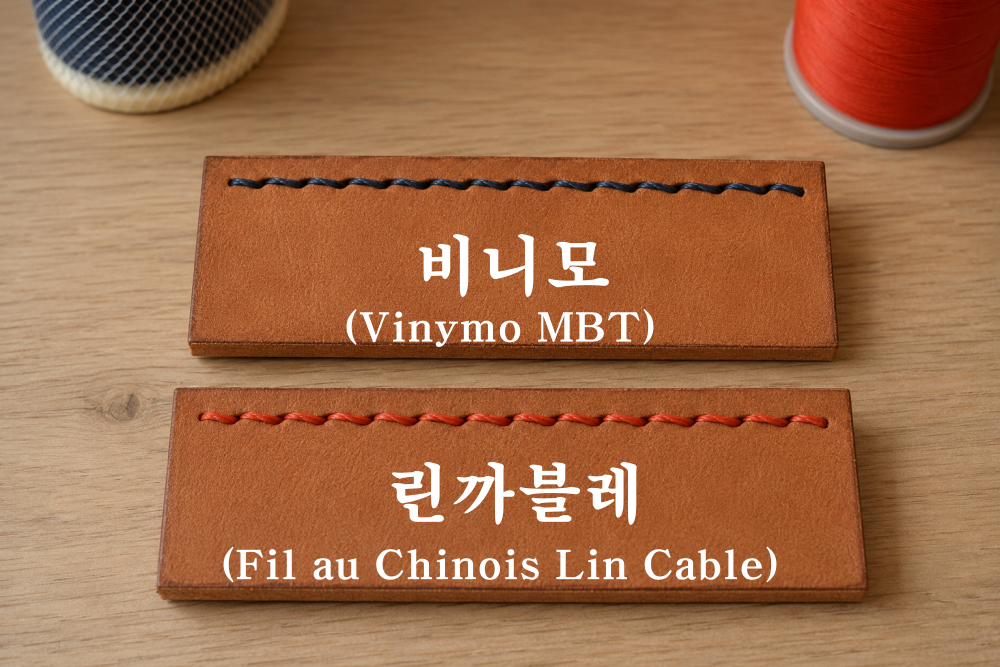
  • 천연 리넨사보다 비니모 MBT를 더 자주 사용하는 이유

    Why I Use Vinymo MBT More Often Than Natural Linen Thread

    In leathercraft, thread is not simply a material for connecting pieces of leather. The thickness, twist, surface texture, and luster of the thread change the impression of the stitches and greatly influence how well the finished bag maintains its shape over time. Even if you use the same leather and the same pattern, the atmosphere of the piece changes significantly depending on the thread you choose.

    Natural linen thread is a traditional material that has been used in leather handcrafting for a long time. Due to its unique natural texture and warm impression, it is still widely loved in high-end leather goods and manual work. However, when actually crafting bags and accessories, I use Vinymo MBT more often than natural linen thread.

    This does not mean that one thread is absolutely superior. It is simply because the characteristics of Vinymo MBT better align with the production standards I value.

    ■ Natural Linen Thread and Vinymo MBT Serve Different Purposes

    Natural linen thread is made from flax fibers. When waxed, the thread gains proper stiffness and friction, allowing it to sit stably within the leather's stitching holes. Because a subtle fibrous feel remains on the surface, the stitch line is not overly smooth. When this natural irregularity meets vegetable-tanned leather, it creates a depth characteristic of a truly handmade object.

    On the other hand, Vinymo MBT is a bonded polyester thread. The twist does not unravel easily, and the thickness and surface condition of the thread are relatively uniform. Even when making long continuous stitches, it is easy to maintain a consistent impression from beginning to end.

    • Natural Linen Thread: Natural and traditional impression / Fibrous surface texture / Calm and soft luster / Waxing required
    • Vinymo MBT: Neat and modern impression / Smooth and uniform surface / Subtle and clear luster / Stable twist and consistent thickness
    동일한 가죽·동일한 간격으로 바느질한 비교 견본

    ■ The First Reason I Use Vinymo MBT More Often: Consistent Stitches Over Long Lines

    Bags have much longer stitching lines than small leather accessories. Parts of varying thicknesses—such as the main body and side panels, the bottom and reinforcements, and the handles and opening—are connected into a single structure. As the stitch line gets longer, the twist and tension of the thread can change slightly. A difference that might not be visible in a short section becomes noticeable as it follows the long outline of a bag.

    Because Vinymo MBT is quite stable in its thickness and twist, it is great for continuing stitches with a consistent rhythm. It makes it easier to neatly arrange not only the slanted stitches on the front but also the stitch appearance on the back. What I want is not just neat sewing. It is for the stitching lines to connect solidly as part of the structure when viewing the bag as a whole.

    ■ The Second Reason: Easy to Reproduce Results in Repeated Production

    If it is a one-off piece, you can adjust the pulling tension of the thread based on the feel of your hands that day. However, it's a different story if you are making multiple items from the same pattern or communicating work standards clearly to others through pattern documents. When applying the same thread thickness, hole size, stitch spacing, and pulling force again, similar results must be achieved.

    Vinymo MBT is perfectly suited for such repeated production. By using a thread of the same specification, the stitch proportions confirmed in the initial work can be reproduced quite stably in the next project. A good pattern should not rely solely on the maker's coincidental hand skills. Even when someone else applies the same standards, the result should come close to the originally intended shape and balance.

    ■ The Third Reason: Great for Considering the Usage Environment

    A bag is not an exhibit kept in a display case; it is an item carried by hand every day. The handles are constantly in contact with human hands, and the bottom and corners create friction against clothes or surrounding objects. It is also fully exposed to rain, moisture, sunlight, and temperature changes.

    Polyester thread generally absorbs less moisture and maintains its color and physical properties stably. Vinymo MBT is also excellent for stitching bags or wallets used daily. Especially for parts that repeatedly bear weight—such as handle attachments, bag bottoms, and openings—you must consider not only the appearance but also the stability to withstand the test of time.

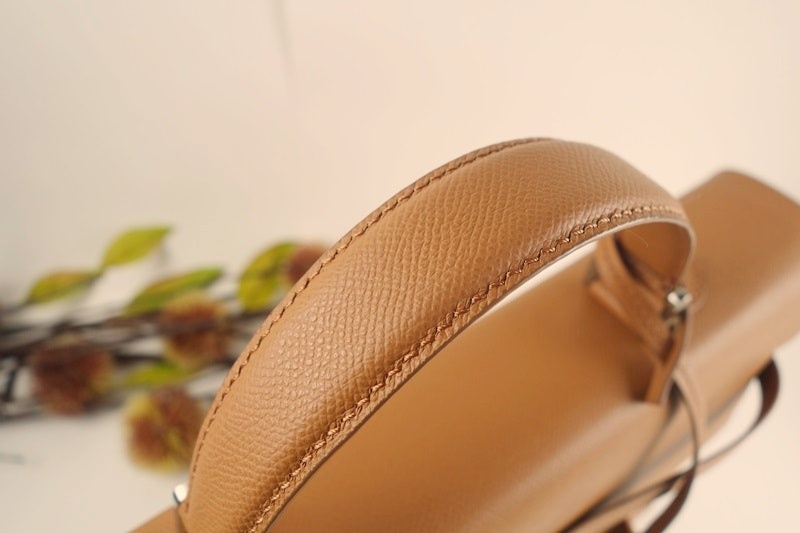
    비니모 MBT를 사용한 가방의 핸들

    ■ Does Vinymo MBT Also Need Wax?

    The bonding treatment of Vinymo MBT does not mean the same thing as waxing. The bonding treatment keeps the thread twist from unraveling, while wax controls the friction and smoothness during sewing.

    I believe that, depending on the working conditions, Vinymo MBT can also be lightly waxed. When passing through long stitch lines or when the friction on the leather edges is high, a little wax helps. However, applying too much wax can attract dust, leave marks on light-colored leather, or make the stitch surface look dull. It is better to apply it thinly and evenly, just as much as needed.

    ■ Then, When Should Natural Linen Thread Be Used?

    It is not that I don't use natural linen thread at all. In the following types of work, the charm of natural linen thread actually shines much brighter.

    • When emphasizing the process of leather aging and breaking in naturally over time
    • When you want to show the unique texture of hand-stitching as a visual element
    • When a heavy, traditional atmosphere is needed
    • For projects where you want to highlight a human touch rather than perfect uniformity

    The subtle fibrous feel of natural linen thread blends very naturally with the process of the leather's color deepening. The thread itself also changes slightly along with the leather, leaving traces of time on the finished product. Therefore, it is right to first consider what atmosphere and usage conditions you are aiming for before choosing a thread.

    시험 봉제 과정

    ■ The First Thing I Check When Choosing a Thread

    When handling new leather or a new pattern, I do not jump straight into the main work. I cut the exact same leather to be used for the project and do a short test stitch.

    First, I check whether the thread passes through the stitching hole too loosely or too tightly. Next, I observe if the leather surface dents or the hole tears lengthwise when the thread is pulled. You shouldn't just look at the appearance on the front; you must also carefully check if the thread sits neatly on the back. Finally, I bend the stitched leather multiple times to ensure the thread does not pop out. A test stitch of just ten stitches can prevent numerous problems in advance.

    ■ What is More Important Than Good Thread is the Right Combination

    In leathercraft, people often try to find only the most expensive or the toughest thread. However, a single thread cannot be the answer for every project. Natural linen thread is excellent for expressing the beauty of handcrafting, while Vinymo MBT provides the reliable stability needed for maintaining uniform shapes and everyday use.

    The reason I use Vinymo MBT more often is not that it is unconditionally superior, but because it better suits the framework of the bags I make, my production methods, and the requirement to maintain shape over a long period. Choosing a good thread is not merely about picking a famous brand. It is about finding the perfect match so that the thickness of the leather, the structure of the pattern, the stitch spacing, and the purpose of the item do not conflict with each other.

  • The Science of Saddle Stitch: Why Hand Stitching Outlasts Machine Stitching

    Those who have not deeply experienced leather crafting often think of stitching as simply a finishing act to connect cut pieces of leather. They might ask if it really matters whether it is stitched rapidly by a sewing machine or sewn stitch by stitch by an artisan's hands, as long as the resulting thread line looks beautiful on the surface.

    However, from the perspective of high-end leather engineering, stitching is not a mere combination. It is a "Structural Engineering" technique that determines the lifespan of a leather product. Today, we will explore the scientific reasons why traditional high-end leather workshops still insist on the "Saddle Stitch," a method dating back centuries, by looking closely at its structural differences from machine sewing.

    1. What is the Saddle Stitch?

    Definition and History

    The saddle stitch, as the name suggests, is a traditional hand-stitching technique originally used when making a horse's "Saddle." It involves connecting a needle to each end of a single thread, utilizing a total of two needles to cross both threads through a single punched hole. A saddle had to fully withstand the rough movements of a horse and the weight of the rider, which meant it required the toughest and most durable structure humanly conceivable.

    Why is it Still Used in High-End Bags?

    No matter how much cutting-edge computer sewing machines have developed today, the reason traditional high-end workshops insist on this demanding hand-stitching method is simple. It is due to its "independent durability" that machines can never replicate, combined with the refined proportional beauty unique to handwork. ..

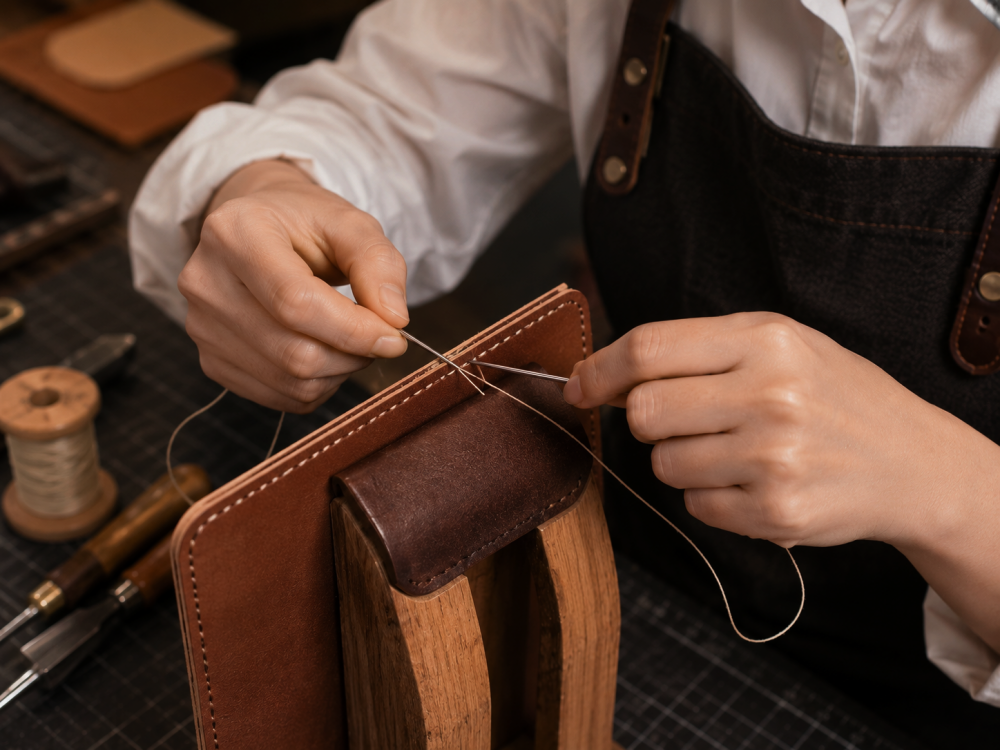
    두 개의 바늘과 린넨 실을 이용하여 포니 위에서 정밀하게 새들 스티치를 구현하는 장인의 손길)

    2. The Critical Structural Difference Between Machine and Hand Stitching

    o understand the difference between machine sewing and the saddle stitch, we must examine the "structure of the knot" and how the threads interlock inside the leather layers.

    CategoryLock StitchSaddle Stitch
    Number of ThreadsTop and bottom threads (2 different threads)Two needles on a single thread (1 continuous thread)
    Interlocking MethodThreads simply loop and twist past each other inside the leatherTwo threads completely cross and knot over each other inside the hole
    Tensile StressIf one part breaks, it unravels like dominoesIf one part breaks, the oppositethread maintains the structure

    The Limitation of Machines: The Lock Stitch

    A sewing machine works by having the top thread pierce through the leather to catch the bottom thread like a loop, pulling it back up. In other words, the two threads are merely "loosely hooked" to each other inside the leather. This structure has a fatal weakness. The moment a single stitch is severed due to friction, the tension holding the upper and lower threads is lost, causing three or four stitches to completely unravel in a domino effect.

    The Strength of Handwork: The Saddle Stitch

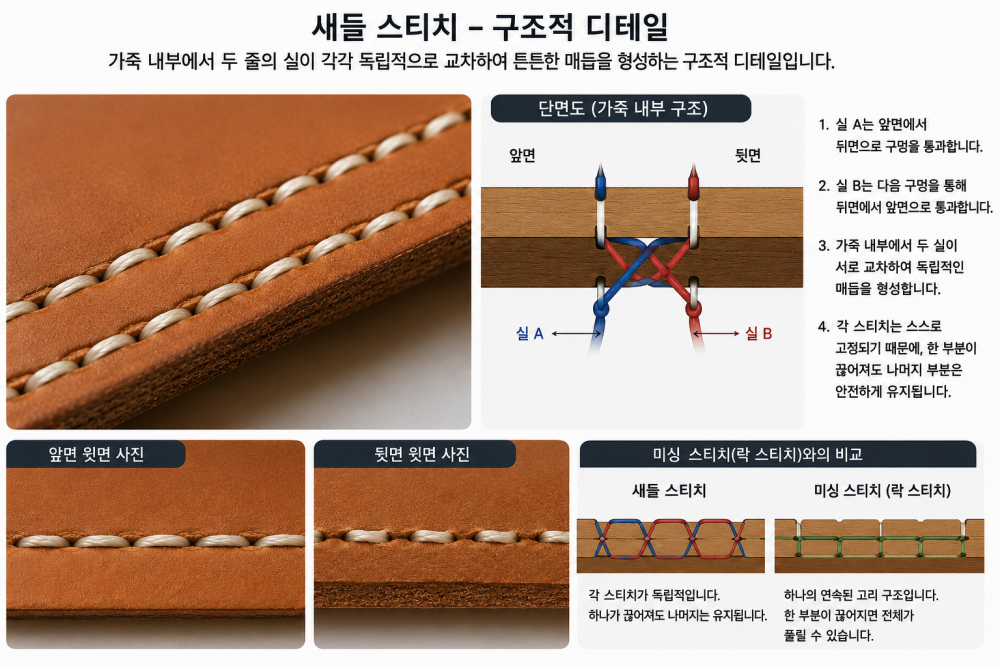
    On the other hand, the saddle stitch allows two lines of thread to cross perfectly in forward and reverse directions within a single hole. It forms a shape where the thread wraps tightly around the inside and outside of the leather like a Möbius strip. This structural difference dictates the lifespan of the bag.

    3. Why is the Saddle Stitch More Durable? The Scientific Principle

    The Principle of Independently Secured Threads

    Every time the saddle stitch passes through a leather hole, the threads form a knot as they move over. Because the two threads are tightly twisted by strong friction inside the leather, each individual stitch is secured as an entirely independent unit.

    The Difference When One Thread Breaks

    Suppose a bag has been used for years, and one line of thread on a high-friction corner finally wears down and breaks.

    • A machine-sewn bag unravels, the leather gap opens up, and the internal reinforcement materials become exposed.
    • In contrast, a saddle-stitched bag remains secure. The other line of thread coming from the opposite side continues to hold the leather together tightly, maintaining its tension thanks to the twisted structure inside the hole. This is the scientific secret that allows hand-stitched bags to be passed down through generations.
    가죽 내부에서 두 줄의 실이 독립적으로 교차하며 견고한 매듭을 형성하는 구조적 디테일

    4. Why an Artisan Chooses the Saddle Stitch Over Machines

    Durability

    Thanks to the structural resilience mentioned above, it perfectly withstands intense friction and the tensile stress caused by the weight of internal belongings.

    Repairability

    When a machine-sewn bag unravels, the entire line of stitching must often be ripped out and resewn from the beginning to look neat. In contrast, a saddle stitch allows for partial repairs (Après-vente), seamlessly blending a few new stitches exactly where the thread broke.

    Aesthetics

    Driven by the consistent tension of an artisan's hands along the pricking iron marks, the thread creates a flowing, three-dimensional diagonal slant that no machine can match. The symmetrical beauty between the front and back sides makes it a work of art in its own right.

    앞면 : 사선 그리프 자리를 따라 칼같이 일정한 각도로 정렬된 새들 스티치 앞면의 유려한 사선 흐름뒷면 : 앞면과 완벽한 대칭을 이루며 한 치의 흐트러짐 없이 견고하게 마감된 새들 스티치 뒷면 라인)

    5. YEGAK's Standards: An Obsession with Structural Perfection

    At YEGAK, we reject stitching that serves as mere visual decoration. We only permit precise stitches that calculate the density of the hidden inner walls and reinforcement materials of the bag.

    • Thread Selection: Instead of the artificial gloss provided by synthetic threads (polyester), we insist exclusively on premium natural French linen thread. It ages beautifully alongside the leather, settling deep into the leather fibers over time.
    • Stitch Spacing: Depending on the size of the bag, the thickness of the leather, and the combination of reinforcements, we specify the exact stitch count during the manual pattern design phase, ranging from size 7 (3.85mm) to size 9 (3.0mm). If it is excessively dense, the leather will tear; if it is too wide, the structural stability compromises.
    • Needle Selection: We carefully select and use premium British saddle needles with rounded, precisely finished tips to ensure they glide smoothly through the leather fibers without forcefully tearing the internal structure.

    6. Conclusion

    "Saddle Stitch is not simply a sewing method. It is a structural engineering technique that determines the lifespan of a leather product."

    Slow but solid—crossing two needles to fill a single stitch takes dozens of times longer than a machine. However, that density of time becomes the lifespan of the bag, and it is the value YEGAK refuses to compromise on.

    In the next chapter, we will take an engineering approach to the foundation of the saddle stitch: "The Differences in Tensile Strength and Aging Between Natural Linen Thread and Polyester Thread."