The Tale of Two Edges: Demystifying Leather Skiving Techniques
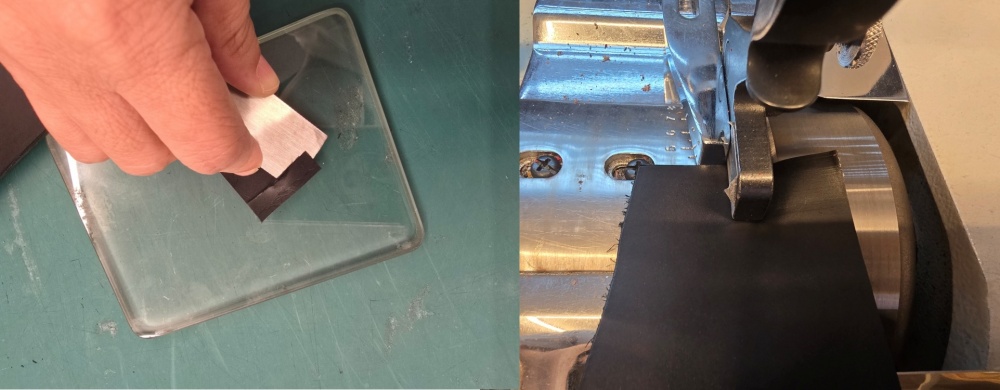
Walk into any high-end leather atelier, and you will find a tool that artisans constantly maintain: the skiving knife. Yet, many intermediate crafters often find themselves confused by technical terminology. Specifically, what is the actual mechanical difference between Standard Skiving and French Skiving?
Choosing the wrong technique at a critical seam is the exact reason a bag fails to lay flush like a Hermès piece, turning instead into a bulky, amateurish lump. Let's deconstruct the mechanics of these two essential disciplines.
1. Standard Skiving (Bevel Skiving): The Linear Incline
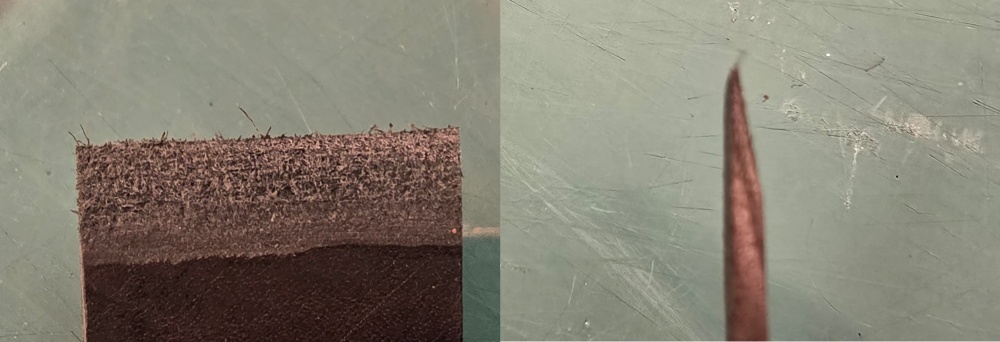
Standard skiving—often called edge beveling—is the process of shaving the leather perimeter at a consistent, diagonal angle (usually between 15° to 30°).
- The Geometry: It creates a smooth, continuous slope from the full thickness of the leather down to a feather-thin edge (e.g., sloping from 1.4mm down to 0.1mm)
- When to Use It: This is your go-to technique for basic raw-edge construction. When you are stitching two panels together and painting the edge with edge coat (giardini/fenice), standard skiving eliminates the double-bulk, keeping the final edge sleek and uniform.
2. French Skiving (Channel Skiving): The Architectural Step-Down
French skiving is a highly specialized, advanced technique where you carve a flat-bottomed rectangular channel into the leather's flesh side, rather than a diagonal slope
- The Geometry: It creates a sharp, right-angled step-down (⎔). The center of the channel is perfectly flat and uniform in thickness.
- When to Use It:** This is absolutely mandatory for **turn-top folded edges (시접)**, pocket T-slots, and premium wallet card slots. By carving a 0.6mm flat channel into a 1.4mm panel, the leather folds over with crisp, geometric perfection. It prevents the folded seam from bloating or creating an awkward exterior bump.

📊 Quick Reference: Technical Comparison
| Technical Attribute | Standard Skiving (Edge Bevel) | French Skiving |
| Cut Shape | Diagonal Slope ( / | Flat-Bottomed Step ( ⎔ ) |
| Primary Tool | Japanese Utility Knife / Round Knife | French Edger / Flat-nosed Chisel Knife |
| Best Used For | Raw-edge joinery, edge painting | Folded edges (turn-top), T-slots, lining tabs |
| Difficulty Level | Medium (Requires steady hand angle) | High (Requires exact depth control) |
3. Beginner Pitfalls: The Cost of a Dull Blade
Achieving a clean French skive on a soft, premium chrome leather (like French Crispe Goatskin) is notoriously difficult for beginners. Here are the two most common mistakes recorded in the YEGAK archive:
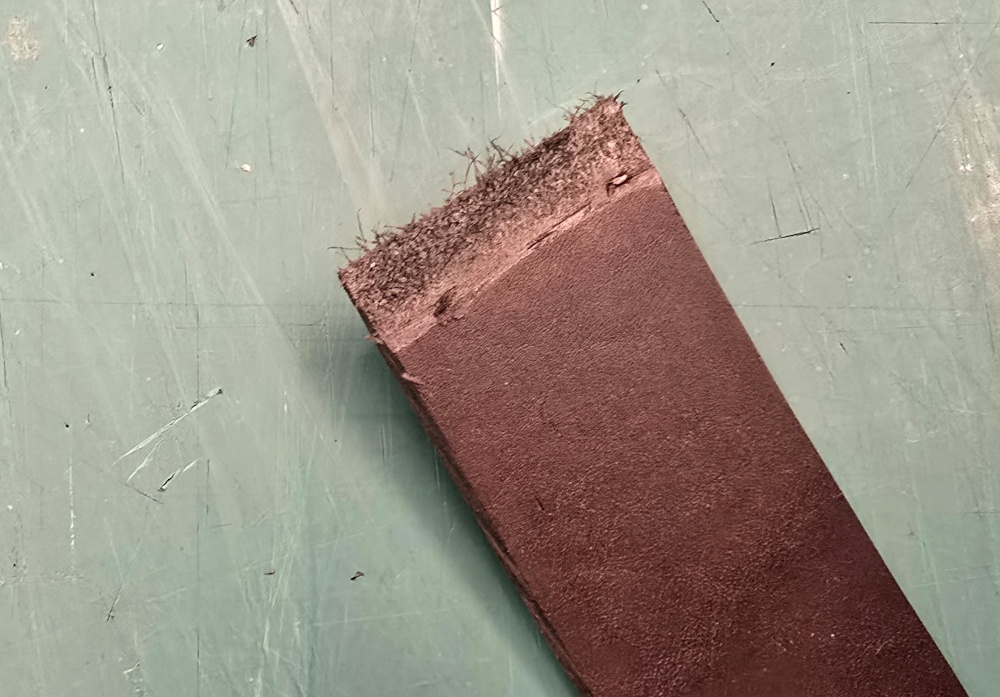
- The Chattered Gouge: Because chrome leather stretches, a dull blade will "hop" and bite into the leather unevenly, leaving ugly corrugated gouges. When you apply water-based adhesive, these uneven depths telegraph directly onto the smooth exterior grain
- The Perimeter Rip:During a standard bevel skive, if the artisan pulls the knife too aggressively at the very edge, the thin 0.1mm foil of leather will stretch and tear, ruining the entire panel alignment
The Master's Secret: Mirror-Polished Maintenance
The secret to taming soft chrome leather isn't brute force; it is microscopic sharpness. Before executing a French skive, a master artisan always strops the blade on leather loaded with chromium oxide compound until it achieves a mirror finish. The blade must effortlessly slice through the dense collagen fibers using only the weight of the hand.
The YEGAK Knowledge Graph: Internal Link Building
To master the complete physical architecture of high-end bag building, connect this practical guide with our foundational engineering theories:
- The Master Framework:** Dive deeper into the microscopic world of collagen networks and knife angles in our comprehensive guide: [The Science of Leather Skiving: Taming Fiber Density with Razor Precision]."Why Skiving is More Than Just Thickness Adjustment"].
- The Physics of Thickness: Master the mechanical formulas for panel thickness before you ever touch the blade.How Leather Thickness Determines Structural Integrity].