The handle is the part of a leather bag that is touched most frequently, while also carrying the full weight of everything inside. Even when the bag body remains intact, stretched handles or weakened attachment points can significantly reduce both usability and overall appearance.
Handle durability cannot be improved simply by using thicker leather. The spacing and placement of the handles, the shape of the internal core, the attachment area, and the reinforcement method must all work together to distribute the load effectively.
Key Principle
A handle is not merely an accessory attached to the top of a bag. It is a structural component that transfers the weight inside the bag to its body.
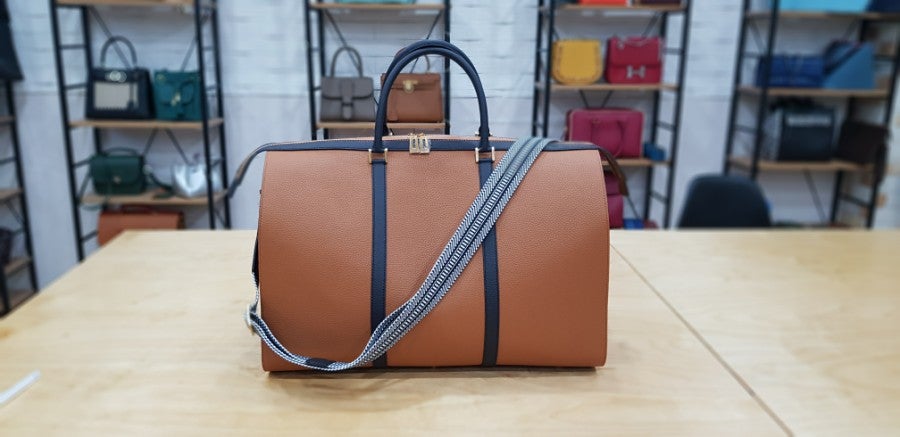
Why Stress Concentrates Around the Handles
When a loaded bag is lifted, the contents pull downward while the handles pull upward. The load is not distributed evenly across the entire handle. Instead, it concentrates around the two points where the handles connect to the bag body.
The wider and heavier the bag, the more complex the forces acting on these attachment points become. In addition to direct tension, the handles pull the leather outward and create bending stress around the connections.
This is why stretching, wrinkling, opened seams, and leather deformation usually appear around the attachment points before they appear in the center of the handles.
Problems Caused by Handles That Are Too Close Together
When the handles are positioned too close together, the load becomes concentrated near the center of the bag. The outer sections receive insufficient support, causing the sides to sag or the opening to fold inward.
On a wide tote bag, handles that are placed too close together may look balanced while the bag is resting. However, its silhouette can change dramatically as soon as it is lifted.
Handle spacing should not be determined by appearance alone. It must remain within a range that allows the bag to be lifted securely around its center of gravity.
Problems Caused by Handles That Are Too Far Apart
When the handles are positioned too close to the outer edges, they pull the opening and side panels outward. If the upper section lacks sufficient reinforcement, the opening may spread and wrinkles may form around the corners.
If an attachment point is located too close to a side seam, the stress from the handle and the stress from the body seam become concentrated in the same area. Repeated use may then stretch the leather or enlarge the stitch holes.
Therefore, when planning the spacing between the handles and the overall proportions of the bagmust be evaluated not only as design elements, but also as structural considerations.
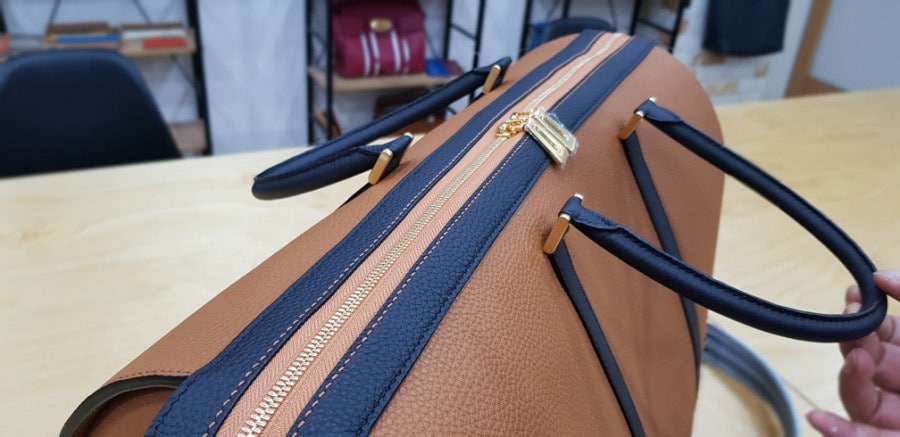
The Direction of Load Distribution Matters More Than the Size of the Attachment
A larger leather attachment does not automatically make a handle stronger. The force received at the attachment point must spread naturally across a wider area of the bag body.
When the attachment ends too abruptly or has a sharply defined edge, stress can concentrate along that boundary. A properly shaped and extended attachment allows the force to spread into the body and the internal reinforcement.
Rather than relying only on visible exterior attachments, the design should carry the load path into the inside of the bag body. At this point, reinforcement at the handle attachment pointshelps prevent the leather from stretching while also maintaining the shape of the attachment area.
What to Check at the Handle Attachments
- Does the end of the handle connect to a sufficiently wide area of the bag body?
- Are the stitch line and hardware holes positioned too close together?
- Does the reinforcement continue into the inside of the attachment area?
- Does the reinforcement end with an abrupt and overly rigid edge?
- Are the positions and heights of the two handles exactly aligned?
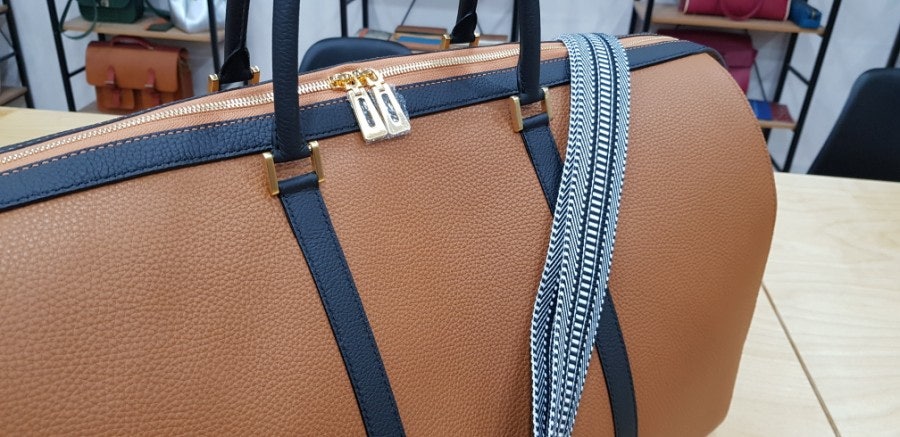
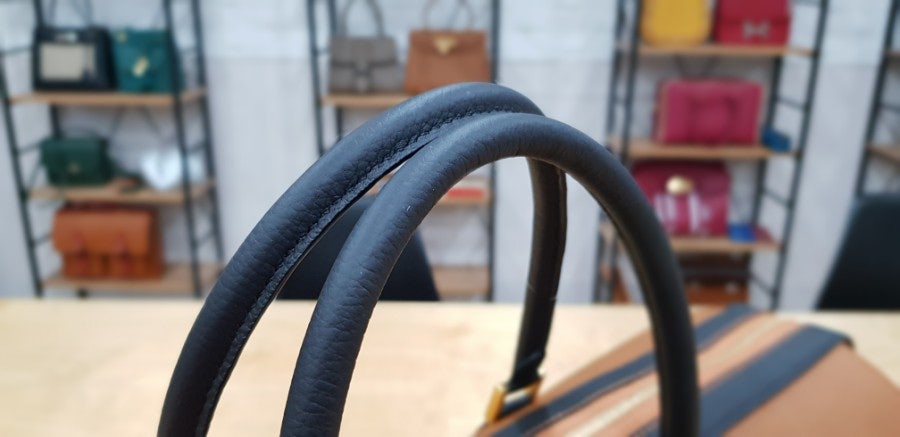
A Handle Core Does More Than Create Thickness
Round or padded handles contain a core that helps maintain their shape. In addition to determining thickness, the core reduces flattening and bending when the bag carries weight.
If the core is too rigid, the handle may feel uncomfortable and fail to bend naturally near the attachment points. If it is too soft, the handle may flatten and lose its shape with repeated use.
The thickness and resilience of the core should be selected in relation to the thickness of the covering leather, the width of the handle, the size of the bag, and its expected carrying weight.
If the edges feel excessively hard or the seam presses directly against the palm, the handle may become uncomfortable during extended use. The tactile quality of the handle should therefore be evaluated alongside its structural durability.
Stitching Can Sometimes Weaken the Leather
It is easy to assume that denser stitching will always make the handle attachment stronger. However, oversized holes or excessively narrow stitch spacing can create a structure similar to a continuous perforation line.
If there is insufficient leather between the stitch line and the edge of the attachment, the leather may tear along the stitch holes when placed under load.
The stitching around a handle attachment should therefore be evaluated not only for visual consistency, but also in relation to leather thickness, fiber condition, hole size, and the margin between the stitch line and the edge.
When metal hardware is used, make sure that the hardware holes and stitch line do not overlap within the same narrow area. Too many holes concentrated in one location can weaken the leather.
Hidden Internal Reinforcement Determines Longevity
Even when the exterior attachment leather is thick, the leather of the bag body may stretch if the inside lacks proper reinforcement.
Internal reinforcement should extend slightly beyond the visible attachment area so that the load can spread into the surrounding structure. However, if the reinforcement ends with an abrupt and rigid edge, the leather may bend along that boundary or reveal an unwanted step.
Rather than making the entire area uniformly thick and rigid, the center should provide sufficient support while the outer edges transition gradually into the surrounding leather.
A Prototype Must Be Tested Under Real Carrying Conditions
Handle placement cannot be fully evaluated from a flat pattern alone. Once the prototype is complete, it should be filled with the expected everyday load and physically lifted.
이때 다음 사항을 확인합니다.
- Does the bag tilt to one side?
- Do the opening and side panels fold inward excessively?
- Do wrinkles concentrate around the handle attachments?
- Do the handles rotate or twist inside the hand?
- Are both handles identical in height and angle?
- Does the overall silhouette remain stable when the bag is loaded?
A bag that looks beautiful while empty is not enough. The handle design is working properly only when the silhouette remains stable under realistic carrying weight.
Well-Designed Handles Stabilize the Entire Bag
Handles may appear to be small components, but they influence the bag’s weight distribution, silhouette, and carrying comfort at the same time.
The handles can maintain their form over time only when their spacing aligns with the bag’s center of gravity, the load spreads naturally into the body and internal reinforcement, and the core and stitching are properly designed.
When evaluating a finished bag, do not look only at the shape of its handles. Observe how the attachment points, opening, and side panels respond when the bag is lifted.
Good handle design is not simply about making the handles stronger. It is about creating a structure that allows the entire bag to carry weight in a stable and balanced way.