The awl is the most fundamental tool in leathercraft. Beginners often focus solely on pricking irons or needles, but it is ultimately the precision of the awl that determines the stitch quality and the overall class of the final piece.
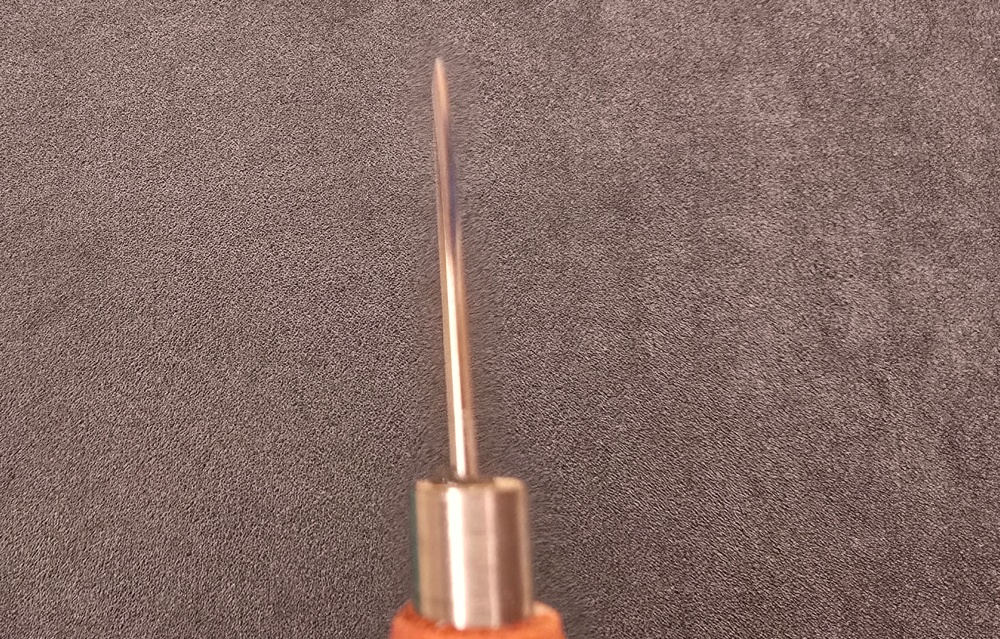
1. An Awl is Not Just a Hole-Punching Tool
| Category | Details |
|---|---|
| Essence of the Awl | Unlike a drill that destroys fibers, it pushes tissues aside to create a path for the thread. |
| Core of Quality | Minimizing fiber damage, perfect stitch alignment by maintaining a consistent angle. |
While a drill rotates and 'destroys' leather fibers, an awl pushes the structure aside to create a 'path' for the thread to pass through. If this path is off by even 1 mm, the tension of the stitching collapses, and the entire stitch line becomes distorted.
2. Types of Awls That Determine Workflow Efficiency
- Diamond Awl: With a diamond-shaped cross-section, it is essential for bringing out the saddle stitch 's signature diagonal thread pattern.
- Round Awl: Ideal for thin leatherswhere tissue damage must be minimized, or for finishing work after punching.
- Scratch Awl: Used for precise marking and engraving guidelines before cutting.

3. Yegak's Philosophy: Blade Maintenance and Angle
What I have realized in my 20 years of leathercraft is that a dull awl 'tears' the leather rather than 'piercing' it. The moment I feel even the slightest resistance during work, I immediately sharpen the blade using a strop.
Even with the same amount of force, if the angle of the awl shifts by just 5 degrees, the position of the hole on the back will be significantly different. The sense of maintaining a perfect vertical angle is the difference in mastery and the detail that creates a premium finish.

Conclusion: A good stitch begins not with the needle, but in the path created by a precise awl.