For those who view leather crafting merely as a hobby, a pattern is often considered nothing more than a temporary drawing on paper used to cut leather. They tend to believe that by simply copying a pre-made commercial pattern, scratching the lines onto the hide with an awl, cutting it out, and stitching it together, a bag will effortlessly manifest.
However, in the elite realm of high-end bag construction, a pattern is far more than a basic drawing. It is a highly sophisticated architectural blueprint that calculates and quantifies the exact thickness of the leather, the structural density of internal reinforcements, the physical tolerance during assembly, and the mechanical forces of gravity acting upon the finished form. In essence, a great bag is already finished on paper; its fate and structural integrity are determined long before a knife ever touches the leather
1. More Than Just a Drawing
Pattern engineering is deeply rooted in architecture rather than art. It is a precise mathematical discipline where flat sheets of heavy paper are systematically drafted and combined to ensure that when the exterior shell and internal reinforcements are physically joined, they sustain a flawless three-dimensional volumetric structure.
Leather is a "living, organic medium"—its fiber orientation, shrinkage rates across different sections, and structural plasticity when introduced to moisture vary constantly. A pattern drafted solely by visual dimensions, without calculating these volatile physical parameters, will never achieve the caliber of a true masterpiece, regardless of how premium the leather is or how precise the saddle stitching appears on the surface.
2. Structural Integrity
When a bag prematurely sags or deforms over time, most crafters quickly blame the choice of internal reinforcements or uneven thread tension. However, the fundamental root of structural failure almost always traces back to the drafting phase—specifically, the failure to calculate material displacement during three-dimensional assembly.
When the exterior leather, internal lining, and rigid reinforcements are layered and bent along a curve, the inner layers must structurally be shorter than the outermost layer. If this microscopic dimensional balance is not tightly controlled on paper down to fractions of a millimeter, the leather will buckle or warp the second the panels are bonded. The crisp lines, proportion, and self-standing majesty of a bag must be absolute on the pattern before assembly begins.

3. The Dynamics of Tolerances (Seam Allowance)
The most catastrophic structural dimensional errors occur within the calculation of seam allowances. As the physical thickness of the leather substrate increases, the geometric gap between the expanding outer circumference and the compressing inner radius widens drastically whenever panels intersect.
When drafting a pattern by hand, a master artisan carefully calculates the specific thickness of the exterior leather, the density of the lining, and even the microscopic volume of the adhesive layers to assign unique skiving margins and seam allowances to each separate panel. If these intricate calculations are slightly off, the entire layout drifts, causing stitching lines to warp diagonally or rendering structural assembly physically impossible.

4. The Mathematical Geometry of Curves
The sweeping, elegant corner arches that define a luxury silhouette or the radical contours of an inverted gusset cannot be accurately generated with basic flat rulers.
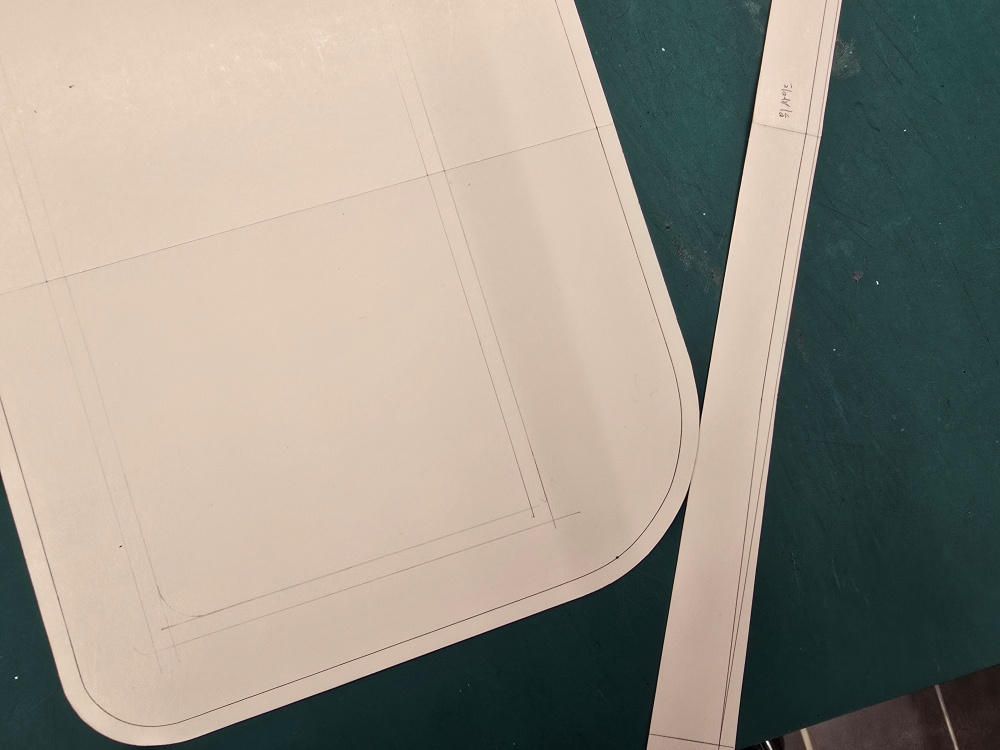
Even if a curved line and a straight line measure exactly the same length on a flat surface, when they are manipulated into a three-dimensional plane, the leather fibers along the curve compress or stretch, altering the true mating length. Rejecting standard grid papers, YEGAK utilizes manual axial and cross-pattern drafting techniques to thoroughly simulate the physical resistance at the precise intersections of radii (R-values) directly on the paper, achieving an absolute mechanical match.
5. Weight Distribution Mechanics (Center of Gravity)
A flawlessly engineered bag maintains its clean geometric profile even when loaded to capacity, ensuring that the mass does not awkwardly lean or shift when held by the handles. This represents the pinnacle of pattern engineering: Center of Gravity Architecture.
The exact mounting angle of the handles, the surface area of the attachment lugs, and the precise boundaries of the bottom base reinforcements must be calculated to strategically distribute stress. A pattern with flawed center-of-gravity engineering will tilt forward or backward when lifted, concentrating intense tensile stress onto a single joint, causing the structural thread lines to rupture and the leather to permanently deform.

6. The Inevitability of Poor Design
Even if a crafter possesses decades of hands-on experience at the workbench, a flawed pattern forces them to forcefully stretch, pull, or cram the leather during assembly to make the edges meet. A bag built under artificial structural stress may look passable on day one, but over time, the inherent elastic memory of the leather will violently pull back toward its true state, causing the entire bag to buckle and sag inward.
To build a true long-term asset that confidently endures for over twenty years, an artisan must never rely on temporary sensory adjustments to coerce the leather. Instead, the material must be guided to rest completely naturally within the absolute, mathematically verified dimensions of an engineered pattern.
7. The Uncompromising YEGAK Discipline
YEGAK strongly rejects over-reliance on digital CAD printouts or highly standardized commercial grid papers. Cold, automated lines can never truly capture or account for the organic elasticity, grain resistance, and nuances of a living hide.
Erecting the primary axes and strict perpendicular guidelines directly by hand, projecting the volumetric density of leather and reinforcements onto the raw paper—this is the very essence of the "slow but solid" pattern engineering philosophy that YEGAK safeguards. Controlling a 0.1mm gap on a sheet of draft paper is the absolute boundary that segregates fine art from commercial mass production.
Next Level: The YEGAK Knowledge Graph
- [Previous Step] Thread Tension and Material Resistance: The Structural Equation of the Traditional Saddle Stitch
- [Next Up] Thread Character and the Function of Aging: Natural Linen Thread vs. Polyester Thread