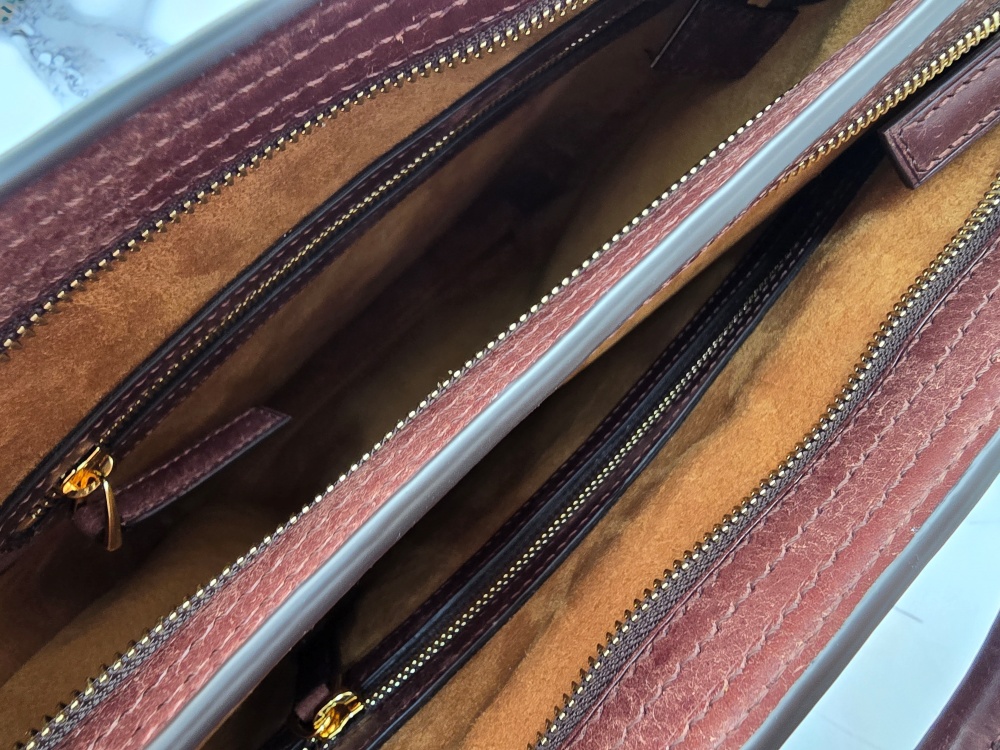
When viewing a finished leather bag from the front, the proportions of the body, the handles, and the color of the leather usually attract attention first. However, once the bag is opened and closed, the opening becomes one of the clearest indicators of its overall quality.
When the zipper is closed, the opening may fail to form a straight line. The center may sag, the ends may lift, or the leather around the zipper may ripple. Even a bag that initially looks well aligned can gradually develop a widened or uneven opening with use.
These problems are not caused by the zipper alone. Leather bag opening design is a structural process determined by zipper length, the thickness of the opening leather, reinforcement, gusset tension, handle placement, and the construction sequence.
A bag opening is not simply a final section completed by attaching a zipper. It is the upper structure where forces from the body panels, gussets, handles, and internal construction come together.

A Bag Opening Must Work Both When Closed and When Open
When designing a bag opening, it is not enough to make it look straight only when the zipper is closed. When opened, it must provide enough space for the hand to enter naturally and for items to be removed comfortably.
If the opening is made excessively rigid, it may look neat when closed but fail to open wide enough. If it is too soft, it may be convenient to use but unable to resist the weight of the contents and the pulling force of the handles, causing the top edge to deform.
The opening must therefore satisfy two conditions at the same time.
- When the zipper is closed, the height and alignment of both sides must remain stable.
- When the zipper is opened, the opening must expand smoothly as needed and then return to its original shape.
A well-designed opening is neither completely rigid nor excessively soft. It maintains a balance between opening movement and shape retention.
Zipper Length Should Not Be Determined Only by the Visible Opening Length
It is easy to assume that a 35-centimeter bag opening simply requires a zipper of the same length. However, the opening length shown on the pattern may differ from the actual path the zipper follows after assembly.
The finished opening length changes when the leather turn-in, gusset seam allowance, zipper-end clearance, and final leather thickness are considered. With a curved opening, the flat pattern measurement may also differ from the actual path followed by the zipper after assembly.
If the zipper is too short, it may pull both ends inward, causing the top edge to curve or the center to rise. If the zipper is too long, the excess length may create ripples in the zipper tape or bulk at the ends.
What to Check Before Determining Zipper Length
- The actual length of the line along which the zipper will sit in the finished bag
- Whether the zipper ends will be concealed inside the leather or left exposed
- The clearance between the zipper stops and the handle attachments
- The amount of length lost when the opening leather is folded
- Whether the opening is straight or curved
- The angle at which the gusset meets the opening
A zipper should not be selected using only a single measurement written on the pattern. Its actual path and movement in the finished bag must be considered first.
Gusset Tension Pulls the Opening Outward or Inward
Although zipper and reinforcement problems are often blamed for a spreading opening, the height and attachment length of the gusset also have a major influence.
If the attachment lengths of the body panel and gusset do not match precisely, one component must be stretched or compressed during assembly. The resulting tension may not be immediately visible, but it can later appear as distortion around the opening as the leather settles with use.
If the gusset is attached too tightly, it can pull both sides of the opening inward. If excess gusset length remains, the ends of the opening may spread outward or develop wrinkles.
For a curved gusset, several matching points should be marked to ensure that the body and gusset are distributed in equal proportions. Aligning only the beginning and end while estimating the middle by eye can create uneven tension between the two sides.
If the two sides of the opening look different, first check whether the body and gusset were joined at matching positions with equal tension before altering the opening line itself.
Stronger Reinforcement Is Not Always Better
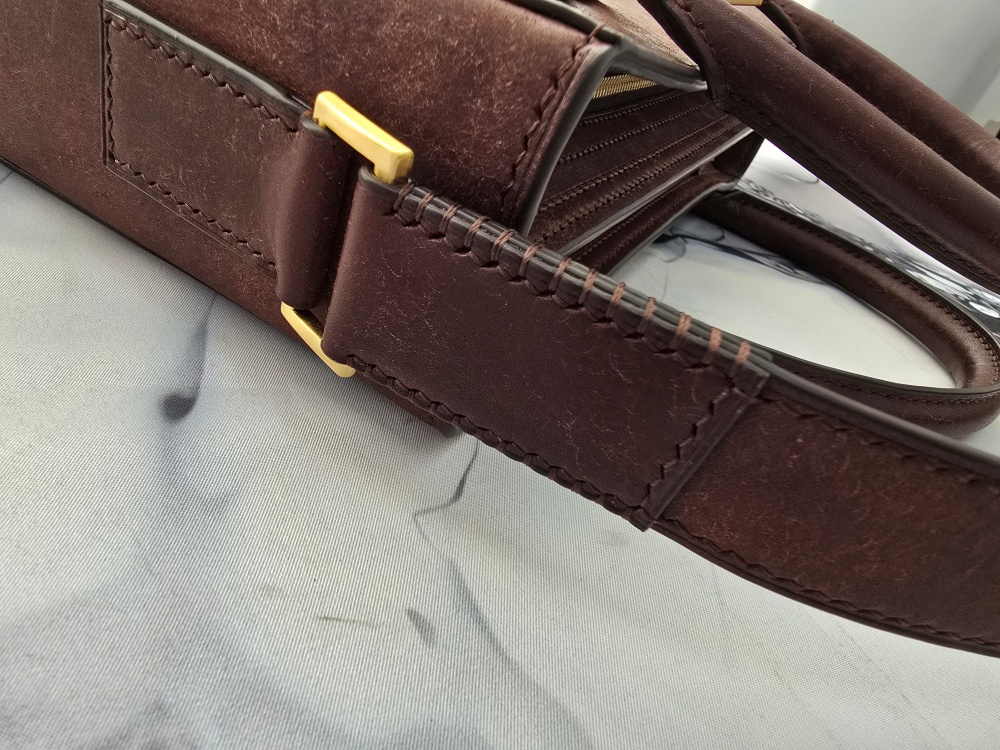
The opening requires reinforcement because it is repeatedly affected by zipper movement and handle loads. However, adding thick and rigid reinforcement does not necessarily produce a better opening.
Excessively rigid material may preserve a straight line but create a sharp bend where the opening meets the gusset. The opening may not expand sufficiently, and repeated movement may eventually reveal the edge of the reinforcement through the leather surface.
Insufficient reinforcement, on the other hand, may allow the top edge to stretch or sag under handle loads and repeated zipper movement.
Therefore, when planning area-specific reinforcement, the opening should not have the same stiffness throughout.
- Reinforce long straight sections sufficiently to maintain a stable top edge.
- Retain flexibility where the opening meets the gusset so that movement is not restricted.
- Reinforce the load-bearing area around the handle attachments separately rather than stiffening the entire opening.
- Taper the reinforcement near the zipper ends to prevent a sudden increase in thickness.
Good reinforcement does not force the leather into a fixed position. It allows the leather to move only where movement is needed.
Uneven Skiving Can Distort the Zipper Line
Where the opening leather is folded and joined to the zipper, multiple layers of leather, reinforcement, zipper tape, and lining overlap. Although the opening appears to be a single line, its internal thickness can vary from one section to another.
If only the zipper ends or gusset connections become suddenly thicker, it becomes difficult to maintain a consistent stitching line and edge height. Forcing layers of different thicknesses together can also cause the opening leather to curl or pull the zipper tape after the adhesive dries.
Skiving does not mean making the entire opening uniformly thin. It means calculating the number of overlapping layers and creating a smooth transition where the finished thickness changes.
Thicknesses to Check Before Assembling the Opening
- The final thickness of the folded leather
- The difference between reinforced and unreinforced sections
- The areas where the zipper tape and lining are added
- The section where the gusset seam allowance overlaps
- The extent to which handle reinforcement continues into the opening
If skiving is based only on the thickness of a single outer leather layer, the assembled section may become thicker than expected. The completed layered structure must always be used as the reference.
Handle Placement Also Affects Opening Deformation
When the bag is lifted, the handles transfer its entire weight to the area around the opening. If the handle attachments are too close to the top edge or the reinforced area is too narrow, the opening may be pulled upward, causing the center to sag or the ends to spread.
If the handles are positioned too close together, the load becomes concentrated near the center. If they are too far apart, they may pull the sides of the opening outward. Handle placement must therefore consider not only visual proportion but also how the opening receives and distributes the load.
To evaluate the stability of the opening, do not inspect only an empty bag. Place a realistic load inside and lift it by the handles. Observe how the top edge is pulled and whether the zipper continues to open and close smoothly.
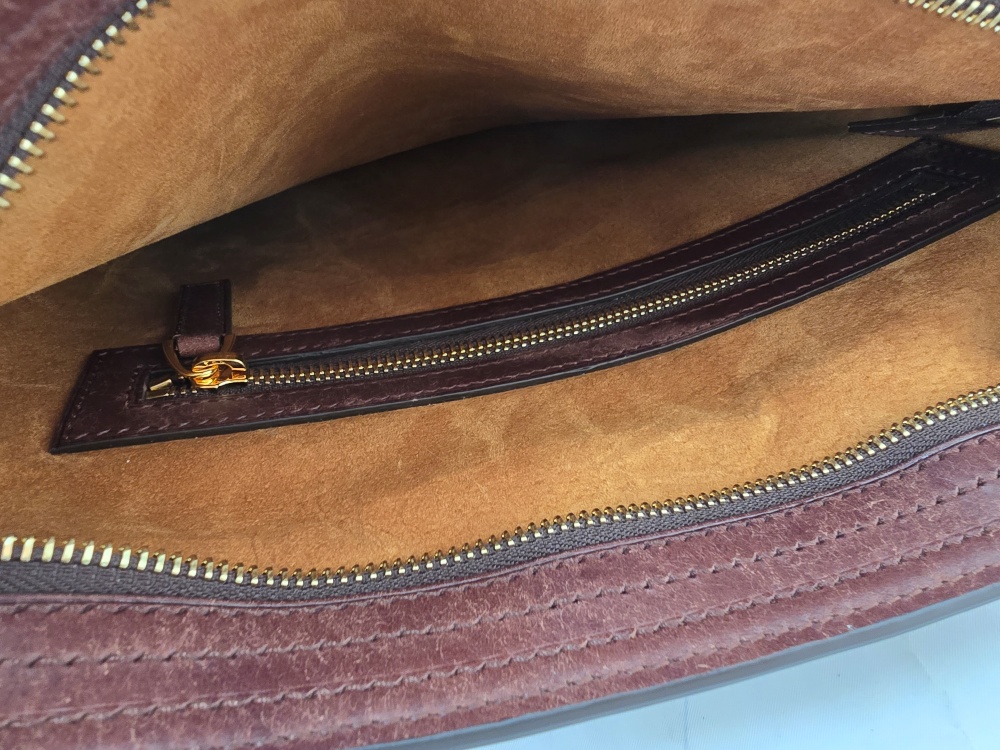
Changing the Construction Sequence Can Alter the Opening Alignment
the leather bag construction sequence, the opening and zipper cannot be worked on independently of the other components. The available working space and alignment references change depending on whether handle reinforcement, zipper attachment, lining assembly, or gusset construction is completed first.
If the zipper is positioned only after the body and gusset have been fully assembled, there may not be enough room for needles or tools. If the zipper is fixed too early, small length differences created while attaching the gusset may become difficult to correct.
Before final stitching, check the following points while the components are temporarily bonded or basted.
- Is the top edge symmetrical when the zipper is closed?
- Does the opening expand naturally when the zipper is opened?
- Does either end of the gusset pull the opening to one side?
- Does the center of the opening sag when the bag is lifted by the handles?
- Does the zipper slider catch on any thick section?
- Does the lining interfere with zipper movement after it is installed?
Any problems found at this stage should be corrected before final stitching and edge finishing.
A Well-Designed Bag Opening Works Without Drawing Attention
A well-designed bag opening may not appear visually dramatic. The zipper moves smoothly without excessive force, the opening expands as much as needed, and the top edge returns to its original position when closed.
Because the opening does not interfere with the bag’s shape and connects the handles, body panels, and gussets naturally, the user rarely notices the structure itself.
When the opening spreads, the zipper line ripples, or one side tilts, the entire bag can appear less refined than it actually is. Even high-quality leather and hardware cannot compensate for an unstable opening line.
Leather bag opening design is not simply the step of attaching a zipper. It is a process that determines both usability and structural quality. A stable opening that retains its shape over time can be achieved only when zipper length, gusset tension, skiving thickness, reinforcement coverage, and handle placement are considered as one integrated structure.